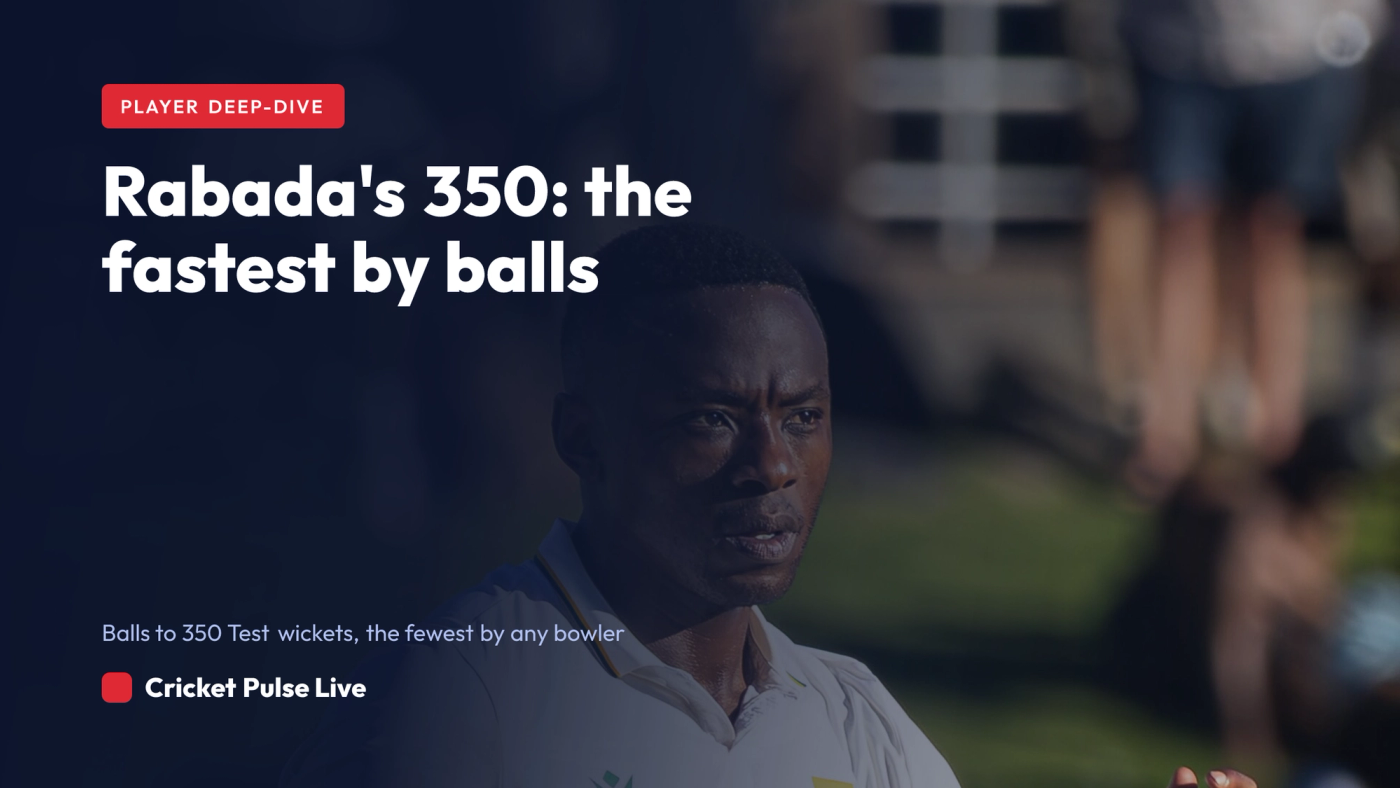
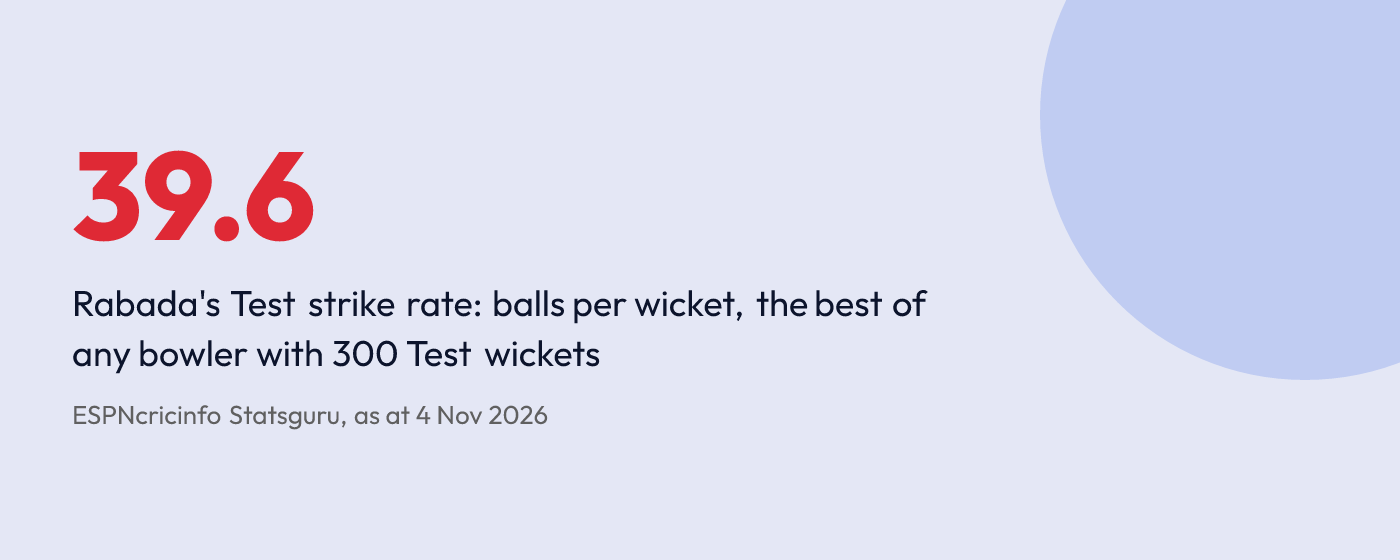
Kagiso Rabada reached 350 Test wickets in 13,808 balls, the fewest by any bowler, beating Dale Steyn (14,719) and Waqar Younis (14,905). It came in his 75th Test, at Newlands on 31 October 2026. His career strike rate of 39.6 balls per wicket is the best of any bowler with 300 Test wickets.
Key takeaways
- Kagiso Rabada took 13,808 balls to reach 350 Test wickets, the fewest of any bowler, ahead of Dale Steyn (14,719) and Waqar Younis (14,905).
- Rabada's career Test strike rate of 39.6 is the lowest of the 42 bowlers with 300 or more Test wickets, as at 4 November 2026.
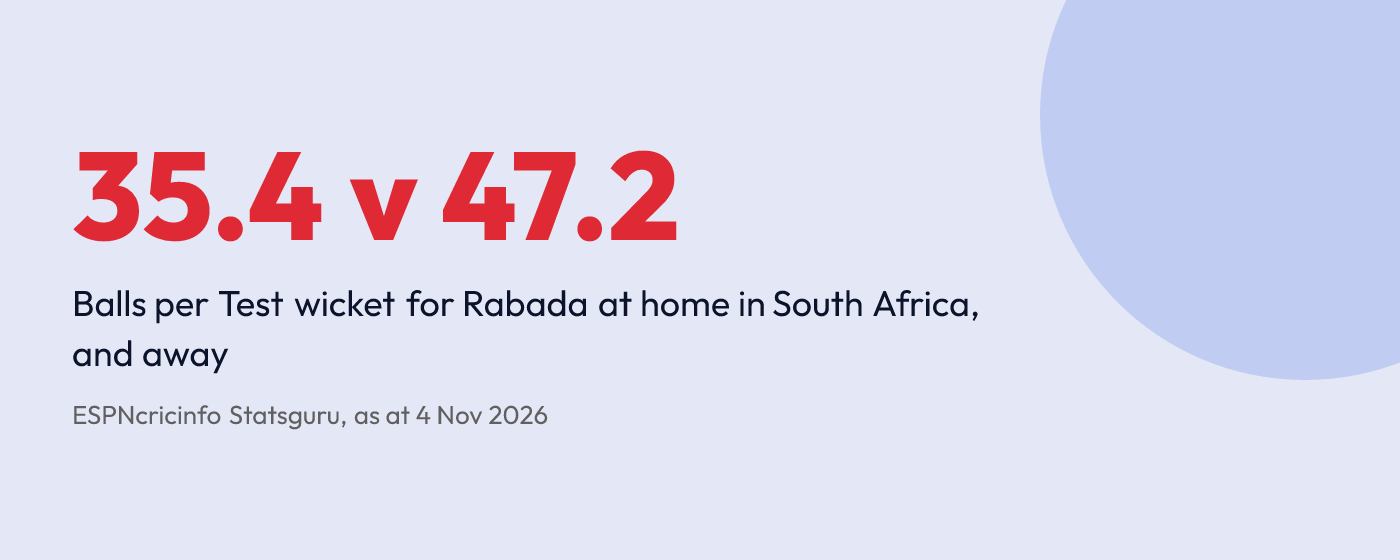
- At home in South Africa he takes a Test wicket every 35.4 balls; away from home it is every 47.2 balls.
- In India and Pakistan combined he has 18 wickets in 10 Tests, his weakest returns anywhere.
- He needs 90 more Test wickets to pass Dale Steyn's South African record of 439.
Kagiso Rabada took his 350th Test wicket on the final day at Newlands on 31 October 2026, removing Travis Head caught at gully as South Africa bowled Australia out for 111 to win the series 2-1. The headline figure is not the 350. It is how few balls it took.
Rabada got there in 13,808 deliveries, according to the Reuters report of the day. No bowler in Test history has reached 350 in fewer. This post looks at what sits underneath that number: the strike rate, the home and away split, and the places where it has not worked.
All figures are as at 4 November 2026, from ESPNcricinfo's Statsguru unless stated otherwise.
What is a bowling strike rate, and why does it matter here?
A bowler's strike rate is the number of balls bowled per wicket taken. Lower is better. Bowling average is runs conceded per wicket. The two measure different things: average tells you how expensive a wicket is, strike rate tells you how long a captain waits for one.
For a fast bowler, strike rate is the figure that shapes a Test. A side with a bowler who strikes every 40 balls can bowl a team out in fewer overs, which leaves more time to win the match. That is why "fewest balls to 350" is a sharper claim than "fewest matches to 350". Matches vary in length; balls do not.
How does Rabada compare with the fastest bowlers to 350?
Reuters gave the ball counts for the three quickest bowlers to the mark. Rabada's margin over the next man is roughly 150 overs.
| Bowler | Balls to 350 Test wickets |
|---|---|
| Kagiso Rabada (SA) | 13,808 |
| Dale Steyn (SA) | 14,719 |
| Waqar Younis (PAK) | 14,905 |
Those gaps are derived directly from the Reuters figures: 911 balls fewer than Steyn and 1,097 fewer than Waqar. Two South Africans at the top of the list says something about the conditions they grew up bowling in, and we come back to that below.
The milestone came in his 75th Test. The ICC's match report describes him as the fourth South African to reach 350 Test wickets.
Where does his career strike rate rank among 300-wicket bowlers?
Statsguru lists 42 bowlers with 300 or more Test wickets. Sorted by strike rate, Rabada sits first.
| Bowler | Tests | Wickets | Average | Strike rate |
|---|---|---|---|---|
| Kagiso Rabada (SA) | 75 | 350 | 22.11 | 39.6 |
| Dale Steyn (SA) | 93 | 439 | 22.95 | 42.3 |
| Waqar Younis (PAK) | 87 | 373 | 23.56 | 43.4 |
| Mitchell Starc (AUS) | 110 | 460 | 25.97 | 45.4 |
| Pat Cummins (AUS) | 77 | 328 | 22.51 | 46.5 |
| Malcolm Marshall (WI) | 81 | 376 | 20.94 | 46.7 |
| Allan Donald (SA) | 72 | 330 | 22.25 | 47.0 |
A strike rate of 39.6 works out at a wicket roughly every six and a half overs. Over a whole career, that is a remarkable rate for a bowler who has played 75 Tests across nine host countries.
His average, 22.11, is also among the best in that group, but it is not the best. Marshall's 20.94 is lower. Rabada is a touch more expensive per wicket than the very stingiest bowlers, and a good deal quicker to each one. That trade-off is the profile of an attacking bowler: shorter spells of pressure, fuller lengths to hunt the edge, and the occasional four.
How much better is he at home than away?
The home and away split is where the record gets more interesting. Rabada has played 39 Tests in South Africa and 35 abroad, plus one at a neutral venue.
| Where | Tests | Wickets | Average | Strike rate |
|---|---|---|---|---|
| Home (South Africa) | 39 | 208 | 20.30 | 35.4 |
| Away | 35 | 133 | 25.61 | 47.2 |
| Neutral (Lord's, 2025) | 1 | 9 | 12.22 | 22.4 |
At home he takes a wicket every 35.4 balls. Away, it is every 47.2. That gap of almost twelve balls per wicket is large, but even the away figure would sit around the middle of the 300-wicket list above, with Cummins and Marshall.
South African pitches tend to reward hitting the deck hard: bounce, seam movement and carry through to the keeper. Rabada's natural method fits that. His one neutral-venue Test, against Australia at Lord's in June 2025, brought nine wickets for 110.
Where has the strike rate not worked?
The clearest weak point is the subcontinent's two biggest hosts. Split by host country, these are his figures away from home.
| Host country | Tests | Wickets | Average | Strike rate |
|---|---|---|---|---|
| England | 7 | 39 | 22.87 | 37.3 |
| West Indies | 4 | 19 | 16.31 | 38.2 |
| Sri Lanka | 2 | 8 | 23.87 | 40.5 |
| Australia | 6 | 26 | 26.46 | 42.8 |
| New Zealand | 5 | 18 | 29.44 | 56.0 |
| Pakistan | 4 | 9 | 42.66 | 84.0 |
| India | 6 | 9 | 44.00 | 92.6 |
| Bangladesh | 2 | 14 | 9.00 | 19.2 |
Combining the India and Pakistan rows gives 18 wickets in 10 Tests, at an average of about 43 and a strike rate of about 88. That calculation is ours, made from the Statsguru host-country figures. On those pitches the ball skids rather than bounces, the new ball softens quickly and spinners bowl most of the overs.
Two caveats matter. First, the samples are small: six Tests in India, the last of them in 2019, and four in Pakistan. Second, in those conditions a fast bowler often bowls fewer, shorter spells and is used to hold an end. A low wicket count there reflects how he was used as much as how well he bowled.
Bangladesh is the counter-example. Fourteen wickets in two Tests in 2024 at a strike rate of 19.2 show that slow pitches alone do not explain everything.
What does his form curve look like year by year?
Rabada's career has three fairly clear phases on the year-by-year figures.
- 2016 to 2018: 155 wickets in 30 Tests, with a strike rate between 36.6 and 38.2 in each of the three years.
- 2019 and 2020: 40 wickets in 10 Tests. The strike rate rose to 44.6, then 58.1 in a two-Test 2020.
- 2021 to 2024: 124 wickets in 26 Tests, with 2022 (47 wickets, strike rate 34.1) and 2023 (strike rate 33.0) his sharpest years.
The 2019 to 2020 dip is the only stretch where the wickets came noticeably slower. Since 2021 he has been back near his best.
The latest stretch is solid rather than spectacular. Across 2025 and 2026 so far he has taken 29 wickets in six Tests at an average of 24.6 and a strike rate of about 42. Again, that is our calculation from the Statsguru yearly rows. In the just-finished series against Australia he took 10 wickets in two Tests, including 4 for 77 in Gqeberha and 3 for 39 in the final innings at Newlands.
How far is he from South Africa's all-time record?
Six South Africans have taken 300 Test wickets. Rabada is fourth on the list and has the best strike rate of the six by a distance.
| Bowler | Tests | Wickets | Strike rate |
|---|---|---|---|
| Dale Steyn | 93 | 439 | 42.3 |
| Shaun Pollock | 108 | 421 | 57.8 |
| Makhaya Ntini | 101 | 390 | 53.4 |
| Kagiso Rabada | 75 | 350 | 39.6 |
| Allan Donald | 72 | 330 | 47.0 |
| Morne Morkel | 86 | 309 | 53.3 |
He needs 90 more wickets to pass Steyn's 439. At his career strike rate that would take a little over 3,500 balls. That is arithmetic, not a forecast: fast bowlers' workloads, injuries and schedules decide these things, not averages. You can follow South Africa's upcoming Tests on the match schedule and their squad on teams and squads.
What does the 350 tell us about Rabada as a bowler?
The numbers describe a bowler whose value is speed of breakthrough. He does not need long spells to change a session, and that showed again at Newlands, where he took two wickets in the first over of Australia's chase.
They also describe the limits. Away from bounce, and especially in India and Pakistan, his returns have been ordinary. Any honest reading of the 350 holds both facts at once.
The win at Newlands also lifted South Africa to the top of the ICC men's Test team rankings, the first time they had been there since January 2016, according to Reuters. The current table is on our ICC rankings page.
Frequently asked questions
Rabada reached 350 Test wickets in 13,808 balls, according to Reuters' report of the third Test against Australia at Newlands on 31 October 2026. That is the fewest of any bowler in Test history, ahead of Dale Steyn on 14,719 and Waqar Younis on 14,905. The milestone came in his 75th Test.
Travis Head was Rabada's 350th Test wicket, caught by Marco Jansen at gully on the fifth day of the third Test at Newlands in Cape Town on 31 October 2026. Rabada had already removed Matt Renshaw and Marnus Labuschagne in the first over of Australia's chase of 288, and South Africa went on to win by 176 runs.
As at 4 November 2026, Rabada's Test strike rate is 39.6 balls per wicket across 75 Tests and 350 wickets, according to ESPNcricinfo's Statsguru. That is the lowest strike rate of any bowler with 300 or more Test wickets, ahead of Dale Steyn on 42.3 and Waqar Younis on 43.4. His bowling average is 22.11.
His figures are clearly better at home. In 39 Tests in South Africa he has 208 wickets at an average of 20.30 and a strike rate of 35.4. In 35 away Tests he has 133 wickets at 25.61 with a strike rate of 47.2, as at 4 November 2026. His weakest returns have come in India and Pakistan.
Dale Steyn holds South Africa's Test wicket record with 439 wickets in 93 Tests. Rabada has 350 in 75 Tests as at 4 November 2026, so he needs 90 more to pass Steyn. Shaun Pollock (421) and Makhaya Ntini (390) are also ahead of him on the national list.
Sources
- K Rabada Test bowling career summary (Statsguru)
- K Rabada Test bowling innings list, 2025 onwards (Statsguru)
- Test bowlers with 300+ wickets, ordered by strike rate (Statsguru)
- South Africa Test bowlers with 300+ wickets (Statsguru)
- Sensational South Africa seal the series in Cape Town
- South Africa vs Australia, 3rd Test, day 5 report
- South Africa's Rabada fastest to 350 wickets as Australia slump to 60-7 (Reuters)
Statistics in this article were checked as at 4 November 2026.