India beat New Zealand by four runs on the DLS method in the second ODI at Wellington on 7 November 2026. New Zealand were bowled out for 134 in 41 overs. Rain stopped India at 113/7 after 26 overs, four runs above the DLS par of 109, and play never resumed. India lead the series 2-0.
Key takeaways
- New Zealand were 53/5 after 20 overs and India 86/5 at the same point, a gap of 33 runs with the same wickets lost.
- Gurnoor Brar took 4/30 from 10 overs, including Tom Latham and Glenn Phillips in the 20th over, and was player of the match.
- India were 113/7 after 26 overs when rain stopped play, four runs ahead of the DLS par of 109.
- India scored 69% of their runs in boundaries against New Zealand’s 45%, which is why seven wickets down was still enough.
- Fifteen of the match’s 17 wickets fell to seam bowlers; the other two went to Axar Patel’s spin.
India won the second ODI at Hnry Stadium, Wellington, on Saturday 7 November 2026 by four runs on the Duckworth-Lewis-Stern (DLS) method. New Zealand made 134 all out in 41 overs. India were 113/7 after 26 overs when rain arrived, and the match never restarted. India now lead the five-match series 2-0, per the ESPN scorecard.
A four-run margin sounds like a coin toss. The numbers say otherwise in places, and agree in others. This analysis covers where New Zealand's innings fell apart, why India's quick scoring mattered more than their wickets, and how the DLS par left India just ahead when the covers came on. All figures are as at 8 November 2026. The remaining games are on the match schedule.
What was the final scorecard summary?
The match was cut to 47 overs a side after a delay before the start. India's captain, Shubman Gill, won the toss and chose to bowl after inspecting a surface with moisture in it, according to the Outlook India live blog.
| 2nd ODI, Wellington, 7 Nov 2026 | Figure |
|---|---|
| New Zealand | 134 all out (41 overs) |
| Top score | Daryl Mitchell 55 off 104 balls |
| Best bowling for India | Gurnoor Brar 10-2-30-4 |
| India at the stoppage | 113/7 (26 overs) |
| DLS par at the stoppage | 109 |
| Best bowling for New Zealand | Kyle Jamieson 10-1-35-3, Jacob Duffy 7-1-35-3 |
| Result | India won by 4 runs (DLS) |
| Player of the match | Gurnoor Brar |
Source: ESPN scorecard and ESPN match page.
Where did New Zealand's innings go wrong?
It went wrong twice: at the start, and again at the end. New Zealand were 23/3 after 8.4 overs. Tim Seifert fell for a duck in the second over and Will Young went at 11/2, both to Auqib Nabi. Henry Nicholls was bowled by Anshul Kamboj for 11.
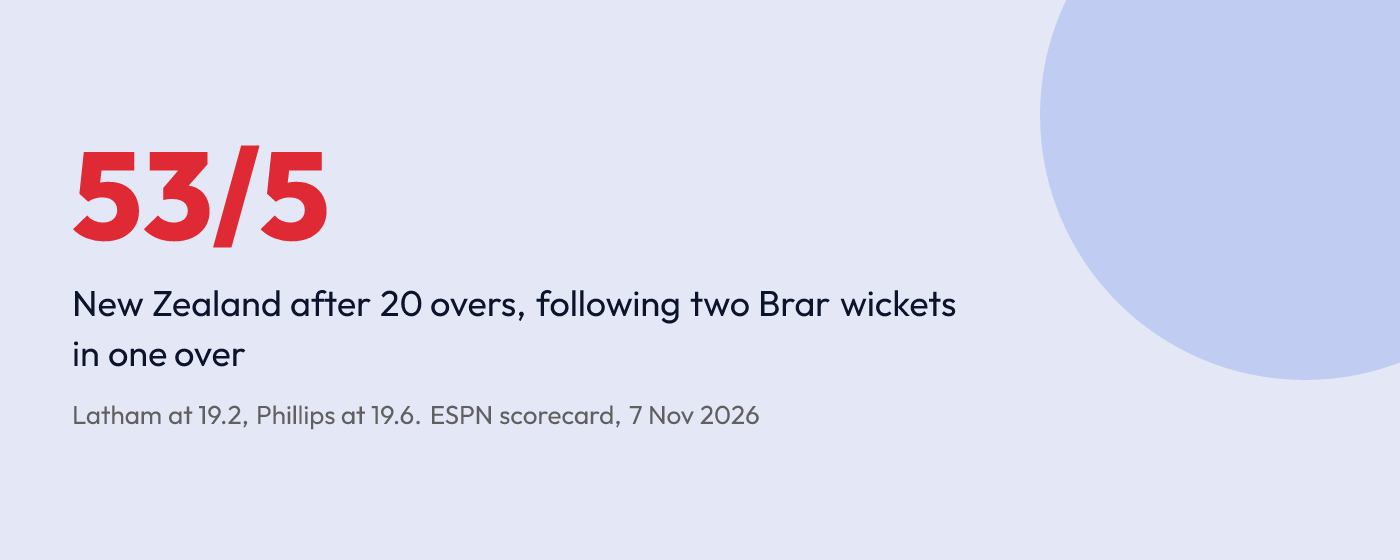
The rebuild stalled in the 20th over. Brar had Tom Latham caught at 53/4 with the second ball and Glenn Phillips caught for a duck with the last. Two wickets in one over left New Zealand 53/5 after 20 overs.
Mitchell and Mitchell Santner then added 59 for the sixth wicket. That stand took New Zealand from 53 to 112 and was the only phase of the innings where the batting side was in control. When Axar Patel had Mitchell caught at 112/6 in the 35th over, the last five wickets fell for 22 runs in six overs.
The fall of wickets shows how thin the scoring was outside that one partnership:
| Wicket | Score | Over | Batter |
|---|---|---|---|
| 1 | 0 | 1.5 | Tim Seifert |
| 2 | 11 | 5.4 | Will Young |
| 3 | 23 | 8.4 | Henry Nicholls |
| 4 | 53 | 19.2 | Tom Latham |
| 5 | 53 | 19.6 | Glenn Phillips |
| 6 | 112 | 34.6 | Daryl Mitchell |
| 7 | 119 | 35.5 | Mitchell Santner |
| 8 | 127 | 38.2 | Kyle Jamieson |
| 9 | 132 | 39.5 | Nathan Smith |
| 10 | 134 | 40.6 | Blair Tickner |
Source: ESPN scorecard.
How did the phases of each innings compare?
The scorecard's powerplay notes split each innings into phases. In the first powerplay (overs 1 to 10, when only two fielders are allowed outside the inner circle), New Zealand made 29/3 and India 40/3. Same wickets, 11 more runs.
New Zealand's middle phase, overs 10.1 to 38, brought 98 runs for four wickets. Their final phase produced seven runs for three wickets before they were bowled out in the 41st over. The ESPN notes do not give India's later phases, but the fall of wickets fills the gap.
| Phase | New Zealand | India |
|---|---|---|
| Overs 1 to 10 | 29/3 | 40/3 |
| Score at 14 overs (drinks) | 43/3 | 49/4 |
| Score at 20 overs | 53/5 | 86/5 |
| Score at 26 overs | not given | 113/7 |
| Final total | 134 all out (41) | 113/7 (26) |
Source: ESPN scorecard match notes. India's 20-over figure is the score at Shreyas Iyer's dismissal (19.6 overs).
At 20 overs, the two sides had both lost five wickets. India had 33 more runs. That gap is the plainest description of the match.
Why did India's run rate matter more than their wickets?
India's chase was not tidy. Gill was caught off the first ball he faced, a golden duck, and Virat Kohli went for 7 at 17/2. India lost seven wickets in 26 overs, which in a full chase would usually be a crisis.
But India scored at 4.34 an over against New Zealand's 3.26. The difference came from boundaries. Adding up each batter's fours and sixes on the ESPN card gives this split:
| Boundaries | New Zealand | India |
|---|---|---|
| Fours | 9 | 12 |
| Sixes | 4 | 5 |
| Runs from boundaries | 60 | 78 |
| Share of total | 45% | 69% |
Derived from the batting figures on the ESPN scorecard.
India hit three more fours and one more six in 15 fewer overs. Rohit Sharma's 23 off 28 balls included two fours and two sixes. KL Rahul's unbeaten 26 off 38 had two of each. Iyer's 30 off 46 was the steadiest innings in the chase, and his stand with Rahul took India from 47/4 to 86/5.
How did DLS decide the result?
Rain took the players off at about 10:10pm local time, according to the ESPN live commentary. The cut-off for the match was 11pm. A restart was discussed for 10:55pm with a 37-over chase, and the ESPN match notes list a revised target of 133 in 37 overs for that scenario. The rain came back and it never happened.
So the result came down to the DLS par at the moment play stopped. DLS sets a par score from two resources: the overs remaining and the wickets in hand. The fewer wickets a side has left, the higher its par for the same number of overs, because its scoring potential is lower.
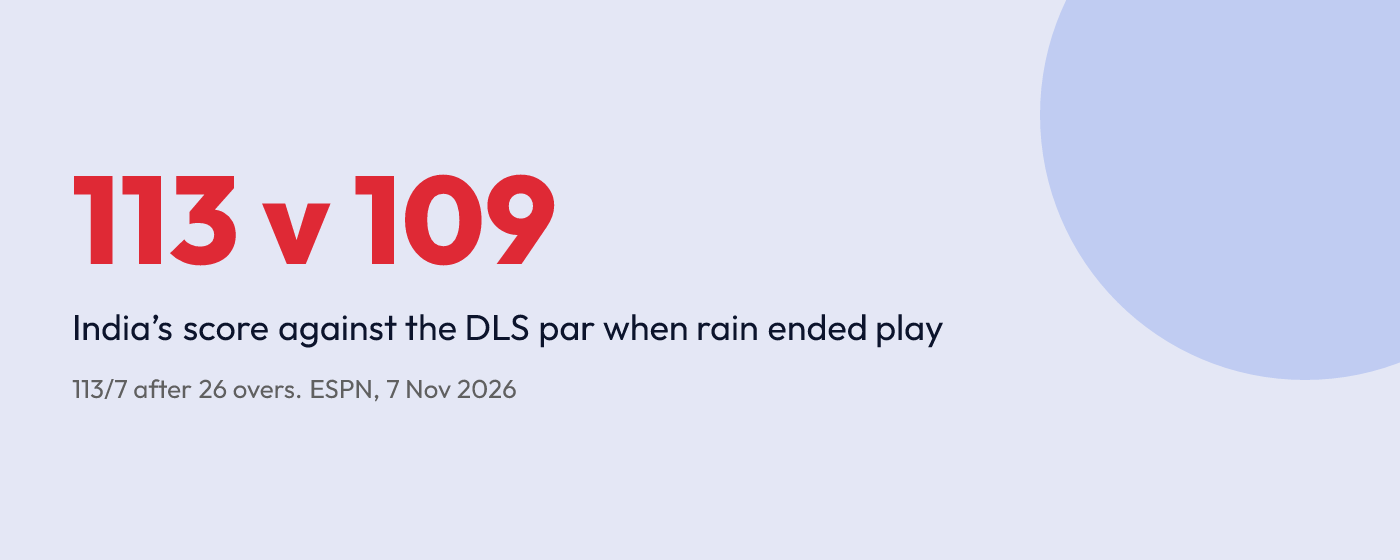
India were 113/7 after 26 overs against a par of 109. They had lost Naman Dhir at 108/6 and Kamboj at 111/7 in the two overs before the rain, so their margin above par had narrowed as the weather closed in. Rahul and Nabi took two more runs off the 26th over. When the umpires called it at 11pm, India were four runs clear.
Wickets set the par under DLS. Runs keep you above it. India lost seven wickets and still stayed ahead because they scored fast enough before they lost them.
What did the seam bowlers do on this pitch?
Of the 17 wickets that fell, 15 went to seam bowlers. The other two were taken by Axar Patel's left-arm spin. Every one of India's seven wickets went to New Zealand's quicks. The ESPN match page's own summary puts the number of wickets to quick bowlers at 15, matching the scorecard count.
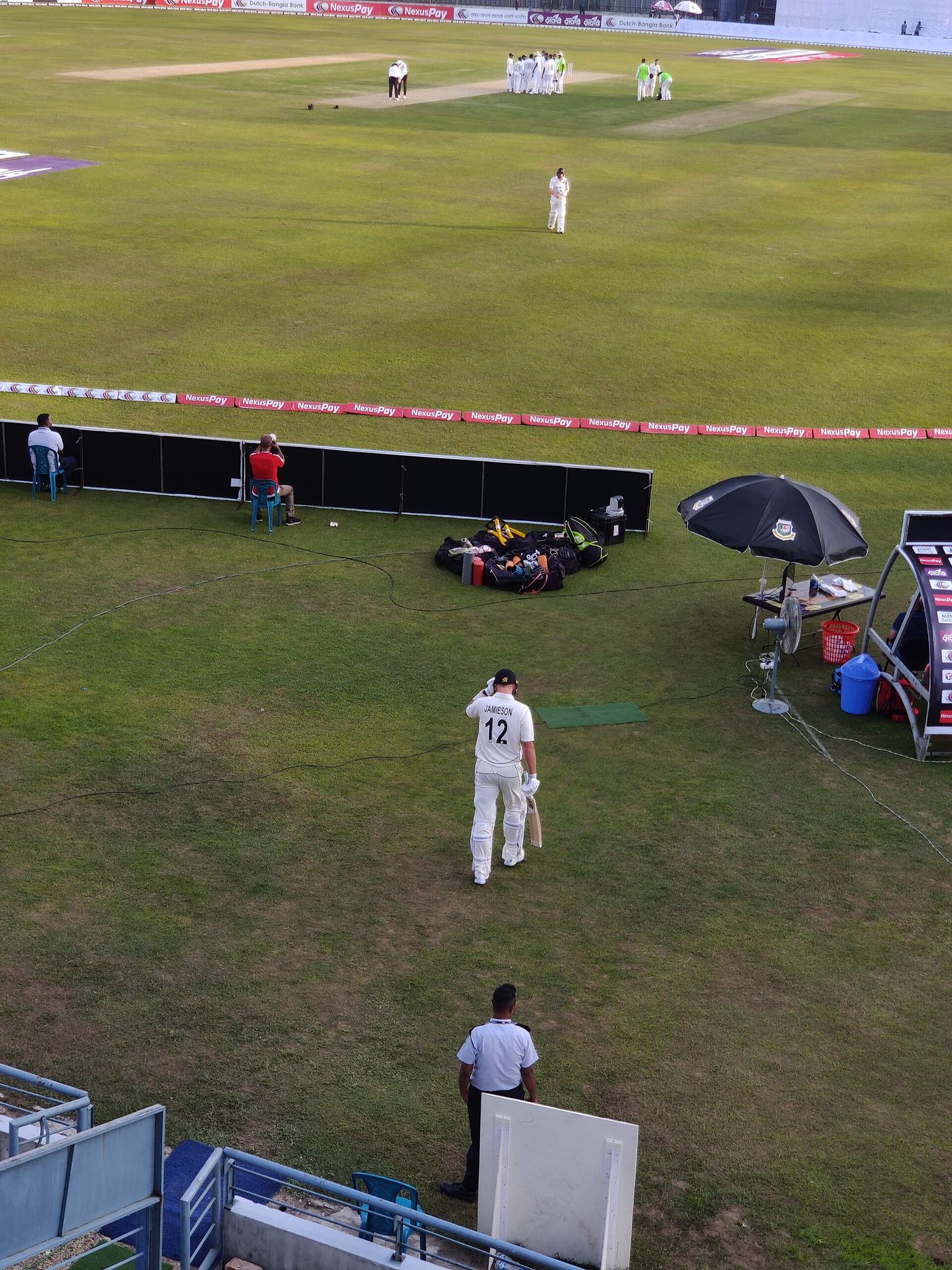
Santner described the surface as "a tricky wicket" after the match, per ESPN. The bowling figures back him up on dot balls. Brar and Jamieson each bowled 47 dot balls in their 60 deliveries.
| Bowler | Figures | Dot balls | Dot-ball share |
|---|---|---|---|
| Gurnoor Brar (Ind) | 10-2-30-4 | 47 of 60 | 78% |
| Kyle Jamieson (NZ) | 10-1-35-3 | 47 of 60 | 78% |
| Arshdeep Singh (Ind) | 7-1-16-0 | 30 of 42 | 71% |
| Anshul Kamboj (Ind) | 8-0-25-2 | 33 of 48 | 69% |
| Jacob Duffy (NZ) | 7-1-35-3 | 27 of 42 | 64% |
Dot-ball counts from the ESPN scorecard; share derived as dots divided by legal balls bowled.

Arshdeep went wicketless but conceded 16 in seven overs. That pressure at one end let Nabi, Kamboj and Brar attack at the other. New Zealand's attack took wickets as freely, but Duffy and Fisher went at 5.00 and 5.75 an over. Those were the overs in which India built the lead that DLS later rewarded.
Was bowling first the right call?
On this evidence, yes. Gill chose to field with moisture in the surface and rain about. His seamers took eight New Zealand wickets, and India then batted knowing any stoppage would be settled on par.
A side chasing in a rain-threatened game also knows exactly what it needs at every point. India could track the DLS par through the chase. New Zealand, batting first, had no such reference for how many would be enough. That is a structural advantage of chasing in a rain-affected one-day match, not a guarantee, and India still had to stay ahead with seven wickets down.
What does the result mean for the series?
India lead 2-0 with three to play, having won both rain-affected games on DLS. They won the first ODI at Eden Park by five wickets, per the Outlook India live blog and the BCCI match summary. The third ODI is in Hamilton, according to ESPN.
For New Zealand, the problem in Wellington was early wickets with the new ball. They were 23/3 before the ninth over was done. For India, the questions are at the top. Gill and Kohli made 7 runs between them in Wellington, and the chase relied on the middle order and on scoring quickly.
- New Zealand need a stable start against India's seamers.
- India's top three made 30 runs between them in this match.
- Both sides' quicks took wickets freely in Wellington conditions.
Follow the third ODI ball by ball on Cricket Pulse Live's live scores, and see every fixture in the India tour of New Zealand series page.
Frequently asked questions
India won the second ODI at Hnry Stadium, Wellington, on 7 November 2026 by four runs on the Duckworth-Lewis-Stern method. New Zealand made 134 all out in 41 overs. India were 113/7 after 26 overs when rain ended the match, four runs above the DLS par of 109. India lead the five-match series 2-0.
The DLS par was 109 when rain stopped play with India on 113/7 after 26 overs, so India were four runs ahead. Players went off at about 10:10pm local time. A restart with a 37-over chase was discussed but rain returned, and the 11pm cut-off passed with no further play.
Gurnoor Brar was named player of the match. He bowled his full 10 overs for 30 runs and four wickets, with two maidens and 47 dot balls. His wickets were Tom Latham and Glenn Phillips in the same over, then Mitchell Santner and Nathan Smith as New Zealand’s lower order fell away.
Under DLS, a side’s par rises as it loses wickets, so seven down is costly. India stayed ahead because they scored at 4.34 an over, well above New Zealand’s 3.26. They hit 12 fours and 5 sixes in 26 overs, so 69% of their runs came in boundaries. That speed built a cushion before the wickets fell.
New Zealand were 23/3 inside nine overs and 53/5 after Brar took two wickets in the 20th over. Daryl Mitchell and Mitchell Santner added 59 for the sixth wicket. After Mitchell fell for 55 at 112/6, the last five wickets went down for 22 runs in six overs, and New Zealand were all out for 134.
Sources
Statistics in this article were checked as at 8 November 2026.