A powerplay limits how many fielders may stand outside the 30-yard circle. In men's ODIs it is two in overs 1–10, four in overs 11–40 and five in overs 41–50. In men's T20Is it is two in the first six overs, then five. Women's internationals allow four after the powerplay. Tests have no powerplay.
Key takeaways
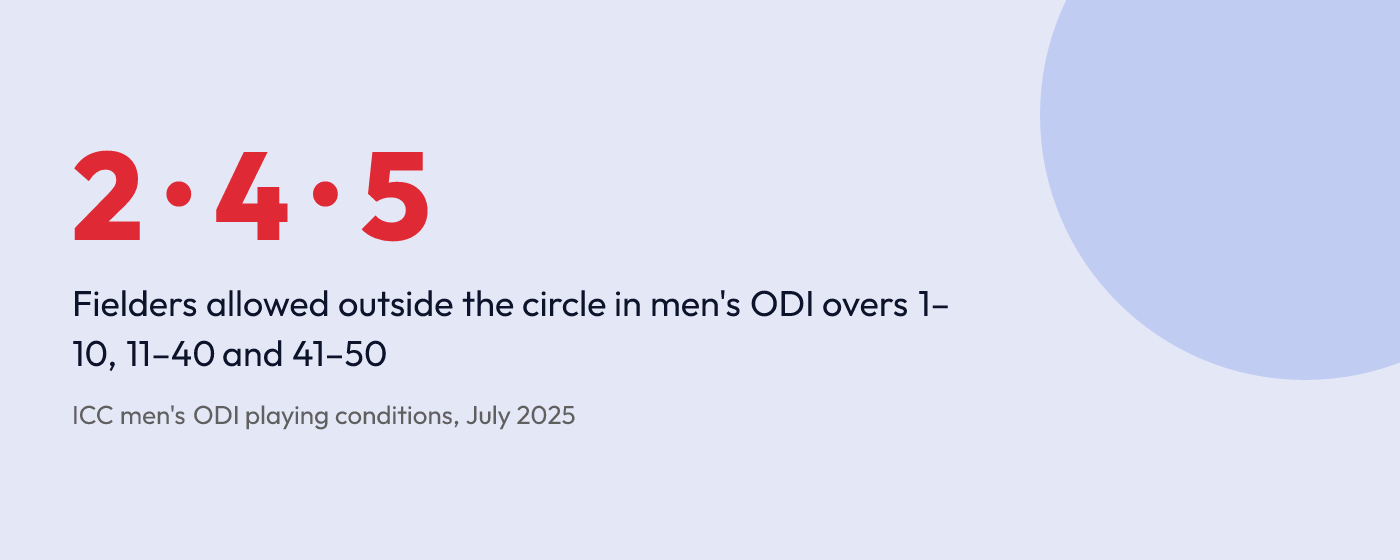
- In a men's ODI, no more than two fielders may be outside the 30-yard circle in overs 1 to 10, four in overs 11 to 40, and five in overs 41 to 50.
- In a men's T20I, two fielders may be outside the circle in the first six overs and up to five from the seventh over onwards.
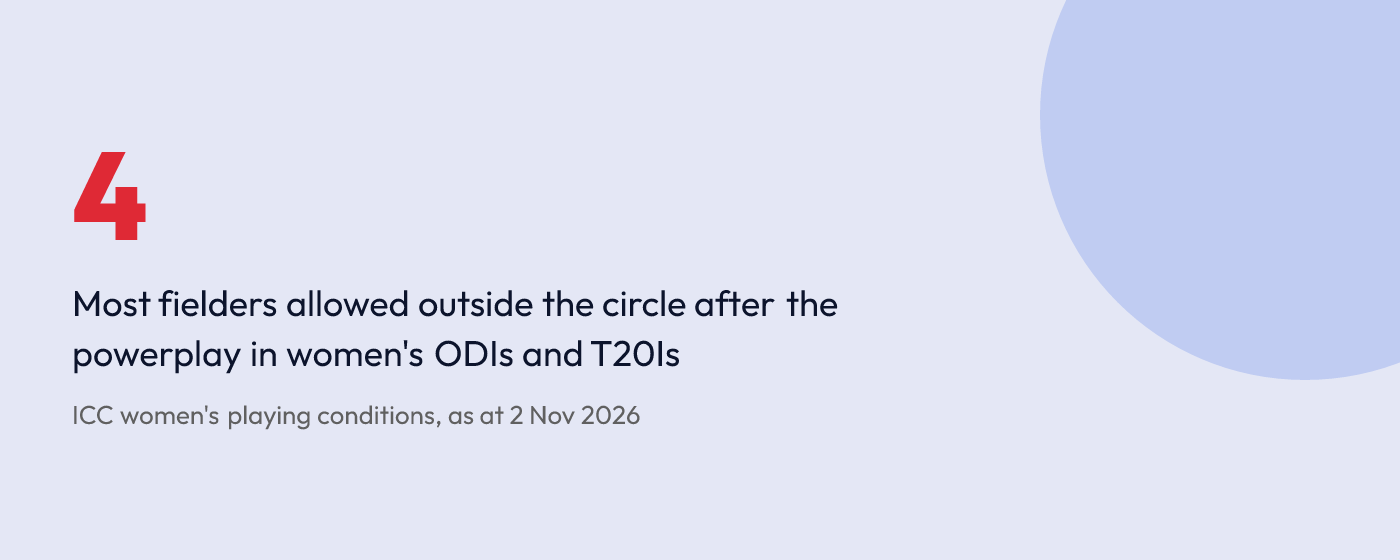
- Women's ODIs and T20Is cap the number outside the circle at four after the opening powerplay, and use a circle of about 23 metres rather than 27.43 metres.
- Since July 2025, a rain-shortened men's T20I powerplay is rounded to the nearest ball, so an eight-over innings has a powerplay of 2.2 overs.
- Breaking a fielding restriction is a no-ball and a free hit, and a slow over rate costs the fielding side one boundary fielder for the rest of the innings.
A powerplay is a block of overs in a limited-overs innings when the fielding side may keep only a few fielders out on the boundary. Everyone else has to stand inside a marked ring. That ring is why the first few overs of a white-ball innings look so different from the middle.
The rules are short, but they differ by format, by gender and by match length. This guide sets them out from the ICC's own playing conditions, as at 2 November 2026.
What is the fielding circle, and how big is it?
Two semi-circles are drawn around the middle stump at each end of the pitch and joined by straight lines, forming an oval. In men's internationals each semi-circle has a radius of 30 yards (27.43 metres). That is why commentators call it "the 30-yard circle".
Women's internationals use a smaller ring. The ICC Women's Championship conditions set the radius at 25.15 yards (23 metres), and the Women's T20 World Cup 2026 conditions at 25 yards (22.86 metres).
| Competition | Circle radius | Source document |
|---|---|---|
| Men's ODI and T20I | 30 yards (27.43 m) | ICC men's playing conditions, July 2025 |
| Women's ODI (Championship) | 25.15 yards (23 m) | ICC Women's Championship 2025–29, July 2026 |
| Women's T20 World Cup 2026 | 25 yards (22.86 m) | Tournament playing conditions |
The ring is marked with a painted line or with white discs every 5 yards. Whether a fielder is "inside" or "outside" is judged at the instant the ball is delivered. Fielders can move once the ball is on its way.
What are the powerplay rules in men's ODIs?
A men's 50-over innings is split into three phases. Each phase caps how many fielders may stand outside the circle.
| Phase | Overs (50-over innings) | Max fielders outside the circle |
|---|---|---|
| Powerplay 1 | 1 to 10 | 2 |
| Powerplay 2 | 11 to 40 | 4 |
| Powerplay 3 | 41 to 50 | 5 |
In practice the first ten overs are when batters can clear the infield with only two sweepers to worry about. The middle 30 overs allow four out, which is enough to protect the boundary on both sides. The last ten add a fifth, because that is when batters are swinging hardest.
The umpire signals the start of the second and third phases by rotating an arm in a large circle. The scoreboard is required to show which powerplay is in progress.
How do the rules change in a shortened ODI?
When rain cuts an innings, the ICC uses a fixed table to shrink all three phases in proportion. It applies to both innings. A few rows from the men's table:
| Overs per innings | Powerplay 1 | Powerplay 2 | Powerplay 3 |
|---|---|---|---|
| 20 | 4 | 12 | 4 |
| 25 | 5 | 15 | 5 |
| 30 | 6 | 18 | 6 |
| 40 | 8 | 24 | 8 |
| 45 | 9 | 27 | 9 |
If play stops mid-innings, the new phases take effect immediately, even in the middle of an over. The ICC's own illustration: a 50-over innings stopped at 8.3 overs and cut to 32 overs becomes 7+19+6. Because 8.3 overs are already gone, the middle phase starts the moment play resumes and runs for another 17.3 overs.
What are the powerplay rules in men's T20Is?
T20Is have one powerplay, not three. During the first six overs, only two fielders may be outside the circle. After that, up to five may be.
There is no second or third phase. From over seven to over 20, a captain can keep five back throughout. That jump from two to five is the biggest single change in field settings anywhere in international cricket.
How long is the powerplay in a rain-shortened T20I?
From July 2025 the ICC changed how a shortened T20I powerplay is worked out. ESPNcricinfo reported the change in June 2025: the length is now rounded to the nearest ball rather than the nearest whole over. The aim is to keep the powerplay close to 30% of the innings.
| Overs per innings | Powerplay length (overs.balls) |
|---|---|
| 5 | 1.3 |
| 8 | 2.2 |
| 10 | 3.0 |
| 12 | 3.4 |
| 15 | 4.3 |
| 18 | 5.2 |
So in an eight-over game, the powerplay ends after two balls of the third over. The umpire signals it, and three more fielders can then drop back. According to ESPNcricinfo's report, the ICC pointed to the English T20 Blast, which had used the same table for years without trouble.
Are the rules different in women's cricket?
Yes, and this is the part many fans miss. Women's internationals allow fewer fielders on the boundary outside the opening block.
- Women's ODIs: a single 10-over powerplay with two fielders outside the circle, then a maximum of four outside for the rest of the innings. There is no five-fielder final phase.
- Women's T20Is: two outside in the first six overs, then a maximum of four, not five.
- Smaller circle: the ring itself is around 23 metres in radius, not 27.43.
The ICC Women's Championship conditions effective July 2026 and the Women's T20 World Cup 2026 conditions both set these limits. One fewer boundary rider changes the arithmetic of the death overs. A captain cannot guard both square boundaries and both straight ones at once.
| Format | Opening powerplay | Max outside after powerplay |
|---|---|---|
| Men's ODI | Overs 1–10, two out | Four (overs 11–40), five (41–50) |
| Women's ODI | Overs 1–10, two out | Four |
| Men's T20I | Overs 1–6, two out | Five |
| Women's T20I | Overs 1–6, two out | Four |
Do Test matches have a powerplay?
No. There is no circle and no limit on how many fielders stand in the deep in a Test. A captain can post nine on the boundary if they want to.
Tests do keep one restriction that applies in every format. At the moment of delivery, no more than two fielders, other than the wicketkeeper, may be behind the popping crease on the leg side. It is clause 28.4 in the ICC's Test conditions, and the same wording appears in the ODI and T20I conditions. Breaking it is a no-ball called by the striker's-end umpire.
ODIs and T20Is add a second leg-side limit: no more than five fielders on the leg side at delivery. The men's Test conditions contain no such clause.
What happens if a team breaks the fielding restrictions?
The square-leg umpire calls a no-ball. That means one extra run to the batting side and a free hit next ball, on which the batter can only be out in the ways allowed off a no-ball, such as a run-out.
There is one exception to the usual free-hit rule. Normally the field cannot change for a free hit unless the striker changes. If the no-ball was for too many fielders outside the circle, the fielding side may move players, but only enough to correct the breach.
Can a slow over rate cost a team a fielder on the boundary?
Yes. This is the in-match over-rate penalty, and it is tied directly to the fielding limits.
- The fielding side must be ready to bowl the first ball of the final over by the scheduled cut-off time for the innings.
- If it is not, then from the next over onwards it loses one boundary fielder for the rest of the innings.
- In men's ODIs and T20Is that means four outside the circle instead of five. In women's internationals, three instead of four.
The penalty is not applied if the innings is completed before the cut-off. It is also switched off when an innings is reduced below 25 overs in an ODI or below 10 overs in a T20I, unless it had already kicked in. Any fines under the ICC Code of Conduct come on top.
Losing a fielder in the last two or three overs of an innings is often more expensive than any fine.
Do domestic leagues use the same powerplays?
Not always. Leagues can set their own playing conditions. The best-known variation is the Big Bash League's Power Surge, introduced by Cricket Australia for the 2020-21 season.
Under that change, the opening powerplay was cut from six overs to four. The batting side then gets a two-over Power Surge, with only two fielders outside the circle, that it can call at any point from the 11th over. The idea was to give batting captains a tactical choice. Check each competition's playing conditions before assuming international rules apply.
Where can you follow powerplay scoring live?
The CPL live scores page shows the score and over count ball by ball, so you can see when a powerplay ends and how the run rate shifts. The match schedule lists the upcoming India and New Zealand white-ball fixtures, and series pages carry the full fixture lists and tables for each tour.
Frequently asked questions
In a men's ODI, two fielders may be outside the 30-yard circle in the first powerplay, overs 1 to 10. The limit rises to four in overs 11 to 40 and five in overs 41 to 50. In women's ODIs, two are allowed in the first ten overs and four for the rest of the innings. These limits come from the ICC playing conditions.
The powerplay in a full 20-over T20I is the first six overs of each innings. Only two fielders may be outside the circle during it. In a rain-shortened match the length is cut using an ICC table, which since July 2025 rounds to the nearest ball. A ten-over innings has a three-over powerplay and an eight-over innings has 2.2 overs.
No. Test cricket has no fielding circle and no limit on how many fielders stand in the deep. The one restriction that does apply is that no more than two fielders, apart from the wicketkeeper, may be behind the popping crease on the leg side when the ball is delivered. Breaking it is a no-ball.
The square-leg umpire calls a no-ball. The batting side gets one extra run and the next delivery is a free hit, on which the batter cannot be out in most ways. Unusually, the fielding side may change its field for that free hit, but only enough to correct the breach that caused the no-ball.
The ICC playing conditions for women's ODIs and T20Is cap the number outside the circle at four after the powerplay, against five in the final phase of men's matches. Women's internationals also use a smaller circle of about 23 metres in radius. The conditions set the numbers but do not state the reasoning behind them.
If the fielding side is not ready to bowl the first ball of the final over by the scheduled cut-off time, it must bring one boundary fielder inside the circle for the rest of the innings. In men's matches that means four outside instead of five. In women's matches it means three instead of four. Code of Conduct fines can apply as well.
Sources
- ICC Men's One-Day International Playing Conditions, effective July 2025
- ICC Men's Twenty20 International Playing Conditions, effective July 2025
- ICC Men's Test Match Playing Conditions, effective June 2025
- ICC Women's Championship 2025-2029 Playing Conditions, effective July 2026
- Playing Conditions for the ICC Women's T20 World Cup 2026
- ICC Women's Twenty20 International Playing Conditions, effective 1 January 2024
- Nearest ball, not nearest over: ICC tweaks powerplay rules for shortened men's T20Is
- Power Surges, Bash Boosts: New BBL rules revealed
Statistics in this article were checked as at 2 November 2026.