In Test cricket, a side that bowls one or more overs short of the minimum rate, after time allowances, is fined 5% of each player's match fee per over short, capped at 50%. In World Test Championship matches it also loses one championship point per over short, with no cap. White-ball sides lose a fielder outside the circle instead.
Key takeaways
- Under Article 2.22 of the ICC Code of Conduct, players are fined 5% of their match fee for each over short, capped at 50%.
- Under Article 16.11.2 of the WTC playing conditions, a Test side loses one championship point per over short, and that deduction has no cap.
- Since July 2019, captains are no longer suspended for slow over rates; every player in the XI is fined at the same level.
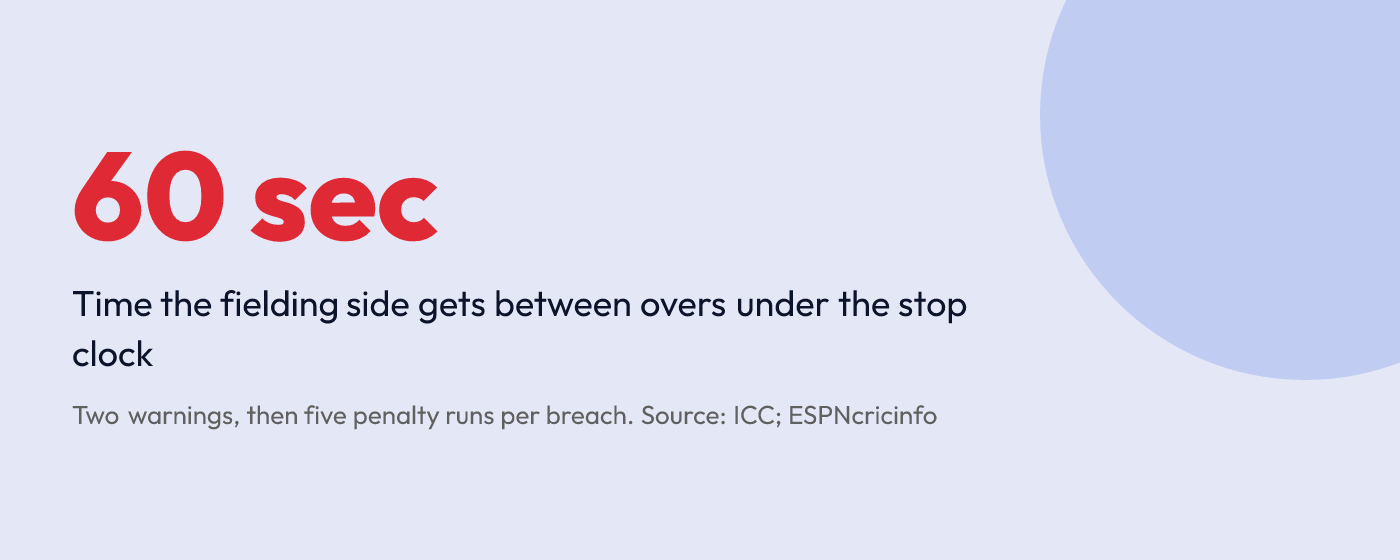
- The stop clock gives fielding sides 60 seconds between overs, with two warnings and then a five-run penalty for each further breach.
- In T20Is since January 2022, and ODIs since 2023, a side behind the clock must bring an extra fielder inside the circle.
Slow over-rates are one of the few offences in cricket where a team can lose something that matters weeks later. A Test side that falls behind the clock does not just pay a fine. It can lose World Test Championship points, and those points cannot be won back on the field.
This explainer sets out what the rules ask for, how the shortfall is counted, and what each format does about it, as at 2 November 2026.
What over rate does a Test side have to bowl?
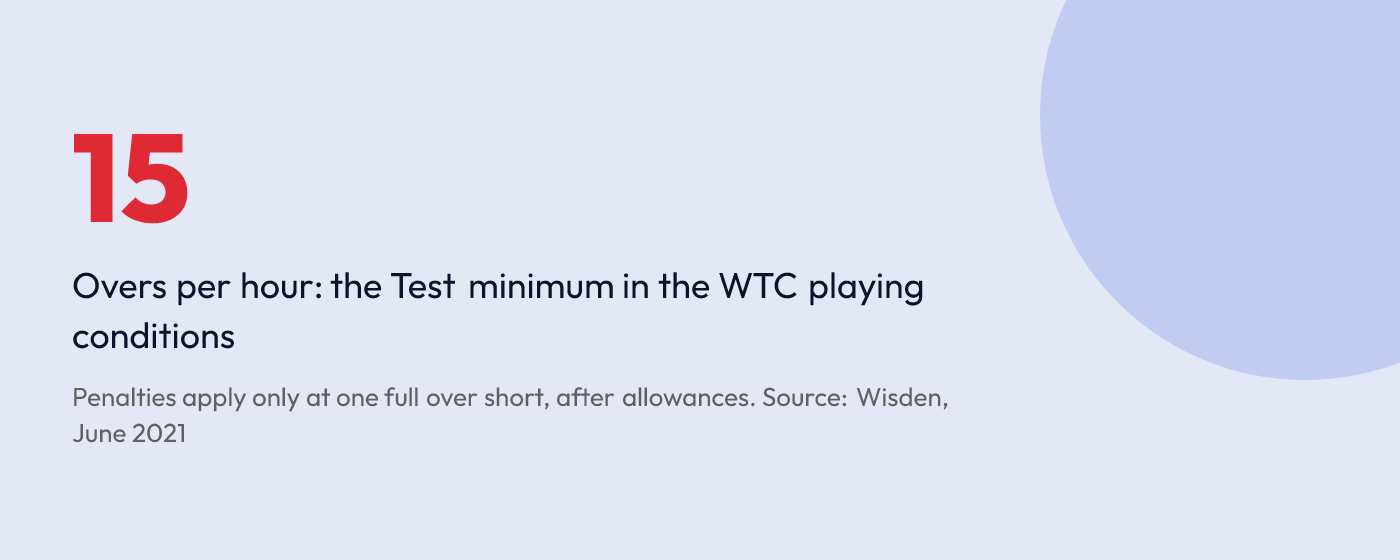
A full Test day is scheduled as 90 overs in six hours. The playing conditions turn that into a rate. The World Test Championship (WTC) playing conditions, as quoted by Wisden in June 2021, set the minimum at 15 overs per hour.
The detail that surprises people is the threshold. A side is only penalised when it is one or more full overs short of the requirement, so in practice a rate a little above 14 overs an hour escapes sanction. Wisden worked through an example: 89 overs in a day's scheduled time came out at 14.13 an hour, below the stated 15 but clear of any penalty.
The rate is calculated across the whole match, not session by session or day by day. A slow morning can be made up by a quick evening, and the umpires settle the final figure only when the match ends.
How are the overs short actually counted?
The umpires start with the time the fielding side spent in the field. They then take off time that was not the fielders' fault before comparing overs bowled against the minimum. The allowances include:
- Wickets: two minutes for each wicket that falls mid-session.
- Drinks: four minutes for each drinks break.
- Reviews and treatment: time for third-umpire referrals, DRS reviews and on-field medical treatment, assessed case by case.
- Batting-side delays: time lost to the batting team is credited to the fielders, not charged to them.
Only what is left after those deductions counts. ICC penalty releases state the shortfall after those allowances, so the headline number of overs short is already the net figure.
What happens when a Test team is short?
Two separate penalties land at once, under two separate sets of rules.
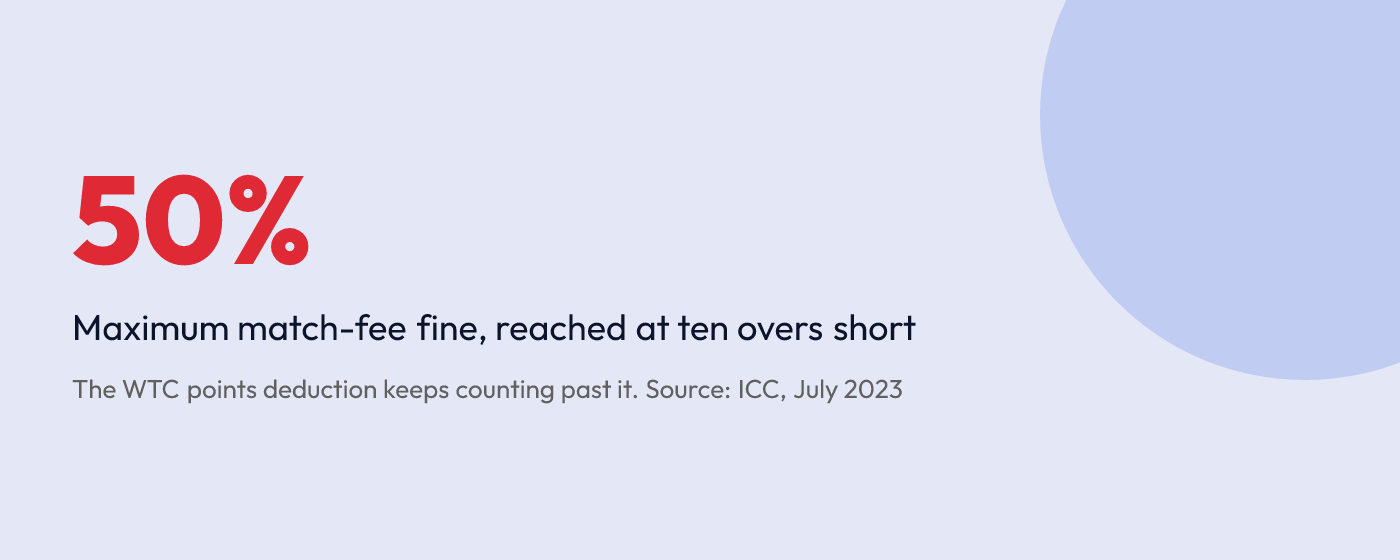
The first is a fine. Under Article 2.22 of the ICC Code of Conduct for Players and Player Support Personnel, every player in the XI loses 5% of their match fee for each over short. The fine is capped at 50% of the match fee.
The second is the WTC deduction. Under Article 16.11.2 of the WTC playing conditions, the side loses one championship point for each over short. Unlike the fine, the points deduction has no cap.
| Penalty | Rule | Rate | Cap |
|---|---|---|---|
| Match-fee fine | ICC Code of Conduct, Article 2.22 | 5% per over short | 50% of match fee |
| WTC points | WTC playing conditions, Article 16.11.2 | 1 point per over short | None |
| Captain ban | Removed in 2019 | — | — |
| Run penalty (stop clock) | Test playing conditions | 5 runs per breach after two warnings | Warnings reset every 80 overs |
That gap between the two caps is where the real cost sits. Once a side is ten overs short, the fine stops growing. The points keep going.
Why does the points deduction matter more than the fine?
WTC tables are ranked on points percentage: points won as a share of points available. A deduction lowers the points won without changing the points available, so it drags the percentage down directly. The full method is in our WTC points explainer, and the current table is on the series page.
England's Oval Test against New Zealand in June 2026 shows the effect. The ICC found England 12 overs short. The fine stopped at 50%, the cap, even though 12 overs at 5% would have been 60%. The points did not stop: England lost all 12, and the ICC reported their points percentage falling from 34.72 to 26.38 as a result.

Which teams have lost WTC points this way?
These are ICC-confirmed cases. Each figure comes from the ICC's own penalty release.
| Match | Team | Overs short | Fine | WTC points lost |
|---|---|---|---|---|
| WTC Final, The Oval, June 2023 | India | 5 | 100% | Final (no points) |
| WTC Final, The Oval, June 2023 | Australia | 4 | 80% | Final (no points) |
| Ashes 2023, four Tests | England | 19 in total | 10–45% per Test | 19 |
| Ashes 2023, Old Trafford | Australia | 10 | 50% | 10 |
| 2nd Test v New Zealand, The Oval, June 2026 | England | 12 | 50% | 12 |
| 3rd Test v England, Edgbaston, September 2026 | Pakistan | 11 | 50% | 11 |
The 2023 final is the reason the rules look the way they do now. Back then each over short cost 20% of the match fee, so India lost their entire fee for being five overs short and Australia lost 80% for being four short.
England's 19 points across the 2023 Ashes came from four Tests: two at Edgbaston, nine at Lord's, three at Old Trafford and five at The Oval. Pakistan's 11 at Edgbaston this September were accepted by captain Babar Azam without a formal hearing, the usual route when a side does not contest the charge.
What changed in 2023?
A month after that final, the ICC rewrote the sanctions. Its July 2023 announcement made three changes, applied from the start of the 2023–25 WTC cycle:
- The fine dropped from 20% to 5% of the match fee per over short.
- The total fine was capped at 50%, after the Men's Cricket Committee said players should not have their whole fee at risk.
- If a side bowls the opposition out before the 80-over mark and the new ball is not yet due, no over-rate penalty applies at all. That replaced an older threshold of 60 overs.
The WTC points deduction was kept. The committee wanted the competition penalty to stay, even as the money penalty was softened.

Do captains still get banned for slow over rates?
No. In July 2019 the ICC Board decided that captains would no longer be suspended for repeated or serious over-rate breaches. Responsibility was spread across the XI instead, with every player fined at the same level as the captain.
That was also when the WTC points penalty first appeared. The 2019 announcement set it at two points per over short. ICC penalty releases from 2023 onwards cite one point per over short instead.
What is the stop clock in Test cricket?
The stop clock is the newer, in-match tool. It has been in use in Tests since the start of the 2025–27 WTC cycle, ESPNcricinfo reported in June 2025.
In short: the fielding side has 60 seconds to be ready to bowl the first ball of the next over. Two warnings, then five runs to the batting side for each further breach.
The clock counts up from zero to 60 on a screen at the ground. In Tests, the two warnings reset to zero after each block of 80 overs, lining up with when a new ball becomes available. The run penalty is the important part: it changes the scoreboard during the match, not a spreadsheet after it.
How do ODIs and T20Is handle slow over rates?
White-ball cricket went in-match earlier. Since January 2022 in men's and women's T20Is, a side that has not started its final over by the scheduled time must bring one extra fielder inside the 30-yard circle for the rest of the innings. That leaves four fielders outside the ring instead of five, which is a real cost at the death.
ODIs adopted a per-over version after the Men's Cricket World Cup Super League ended in 2023. For each over a side is behind when the innings' scheduled time runs out, one more fielder must stand inside the ring. If only 48 overs are done on time, the last two are bowled with four outside the circle.
The between-overs stop clock is also permanent in white-ball cricket. After a trial from December 2023, the ICC made it a mandatory playing condition in all Full Member ODIs and T20Is from 1 June 2024, citing around 20 minutes saved per ODI during the trial. The clock is cancelled when a new batter arrives between overs, at an official drinks break, or for umpire-approved injury treatment. Players can still be fined under the Code of Conduct, but the fielding restriction is the penalty a team feels immediately. Every live game is on our live scores page.
Does a side bowled out quickly still get punished?
Usually not. Bowling a side out early is the cleanest defence against an over-rate charge in a Test. Under the 2023 rule, if the fielding side dismisses the opposition before 80 overs and the new ball is not yet due, that innings carries no penalty however long the overs took.
The logic is simple. A team bowling the opposition out cheaply is not the one wasting the paying spectator's day. The rules aim at sides who bowl 85 overs in a day of long batting, not ones who finish the job in 60.
Frequently asked questions
Under Article 16.11.2 of the World Test Championship playing conditions, a team loses one championship point for every over it is short of the required rate, after time allowances. There is no cap on the deduction. England lost 12 points for being 12 overs short at The Oval in June 2026, and Pakistan lost 11 at Edgbaston in September 2026.
Under Article 2.22 of the ICC Code of Conduct, each player is fined 5% of their match fee for every over the side is short, capped at 50% of the match fee. The cap came in with the ICC's July 2023 changes. Before that, each over cost 20%, which is how India lost their whole fee at the 2023 World Test Championship final.
No. The ICC Board decided in July 2019 that captains would no longer be suspended for repeated or serious over-rate breaches. Responsibility now sits with the whole playing XI, and every player is fined at the same level as the captain. The WTC points deduction applies to the team, not to any individual.
The stop clock requires the fielding side to be ready to bowl the first ball of the next over within 60 seconds of the previous over ending. In Tests it has applied since the start of the 2025-27 World Test Championship cycle. After two warnings, each further breach costs five penalty runs, and the warnings reset after every 80 overs.
Generally not in Tests. Under the ICC's July 2023 changes, if a fielding side bowls the opposition out before the 80-over mark and the new ball is not yet due, no over-rate penalty is imposed for that innings, whatever delays occurred. This replaced an older threshold of 60 overs.
Since January 2022 in both men's and women's T20Is, a side that has not started its final over by the scheduled time must move one extra fielder inside the 30-yard circle for the rest of the innings. That leaves four fielders outside the ring instead of five, which is a significant handicap in the final overs.
Sources
- ICC announces changes to over-rate sanctions
- England docked WTC points for slow over-rate in Oval Test
- Pakistan penalised for slow over-rate in Edgbaston Test
- India and Australia fined for slow over-rates in WTC Final
- England and Australia hit with sanctions for Ashes Tests
- ICC board and full council concludes in London
- Stop clock set to become a permanent fixture in white-ball internationals from T20 World Cup 2024
- ICC makes changes to Playing Conditions
- Stop clock for Tests, no ball change after use of saliva, new DRS protocols and more
- Slow over-rate penalty: extra fielder inside circle to be introduced in ODIs too
- Why the ICC's minimum over-rate requirement is anything but
Statistics in this article were checked as at 2 November 2026.