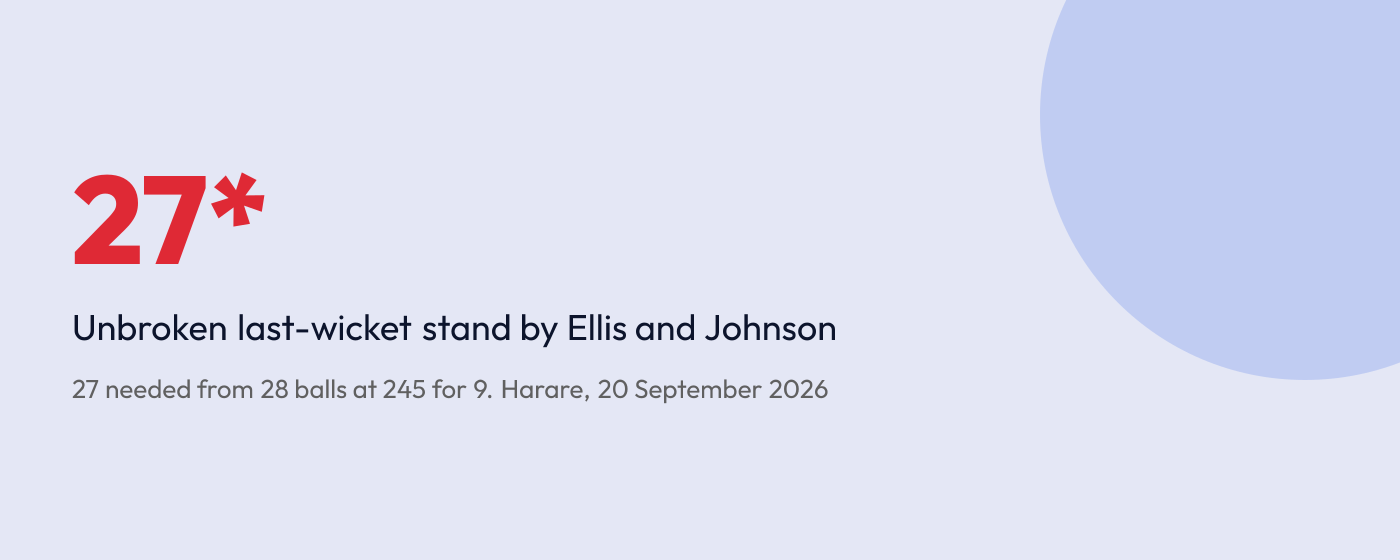
Australia beat Zimbabwe by one wicket, with one ball to spare, in the third ODI at Harare on 20 September 2026. Chasing 272, they were 245 for 9 with 27 needed from 28 balls. Nathan Ellis (36 not out) and Spencer Johnson (7 not out) added 27 unbroken for the last wicket to complete a 3-0 sweep.
Key takeaways
- Australia chased 272 at Harare and won by one wicket with one ball remaining on 20 September 2026, completing a 3-0 ODI series sweep of Zimbabwe.
- Nathan Ellis and Spencer Johnson added 27 unbroken for the tenth wicket after Australia slipped to 245 for 9 in the 46th over.
- Zimbabwe were 148 for 3 when Innocent Kaia retired hurt on 55 with a hamstring injury, and finished on 271 for 8.
- Brad Evans took 4 for 47 and Sikandar Raza, Graeme Cremer and Wessly Madhevere bowled 24.5 overs for 129 runs and five wickets.
- Wessly Madhevere bowled the final over with nine to defend; the first ball went for six and Australia won off the fifth.
Australia's 3-0 sweep of Zimbabwe finished with a one-wicket win and one ball to spare at Harare Sports Club on 20 September 2026. The scoreline says one-sided series. The third ODI says something else: for long stretches of the chase, Zimbabwe were the side in control.
Zimbabwe made 271 for 8 after choosing to bat. Australia got there at 272 for 9 in 49.5 overs, with No. 9 Nathan Ellis and No. 11 Spencer Johnson adding 27 unbeaten runs for the last wicket. All figures below come from the ESPNcricinfo scorecard and match reports, as at 27 September 2026.
How close did Zimbabwe come to beating Australia?
Very close, and for a long time. The cleanest way to see it is the equation, not the scorecard. The table below tracks what Australia needed at each wicket from the middle of the chase onwards. The balls-remaining figures are derived from the overs column of the fall of wickets.
| Moment | Score | Overs | Needed | Balls left |
|---|---|---|---|---|
| Carey out | 162/4 | 25.5 | 110 | 145 |
| Bartlett out | 206/7 | 36.4 | 66 | 80 |
| Inglis out | 227/8 | 41.1 | 45 | 53 |
| Zampa out | 245/9 | 45.2 | 27 | 28 |
| Start of 49th over | 255/9 | 48.0 | 17 | 12 |
| Start of 50th over | 263/9 | 49.0 | 9 | 6 |
Look at the Zampa line. With one wicket left, Australia needed almost a run a ball for four and a half overs. The batters at the crease were a fast bowler batting at No. 9 and the No. 11.
What they did not do was panic. Ellis faced 44 balls for 36 not out. Across the next 3.4 overs the pair took the requirement from 27 down to nine, which left the final over needing one big hit and some calm.
What did Innocent Kaia's hamstring cost Zimbabwe?
Nobody can measure it exactly, but the timing hurt. Kaia had 55 from 66 balls and was sharing an 80-run fourth-wicket stand with Craig Ervine when he pulled up with a right hamstring injury while running a quick single, according to cricket.com.au. Zimbabwe were 148 for 3 after 28.5 overs. He did not return.
From there, Zimbabwe added 123 in the last 21.1 overs. The innings breaks into five phases.
| Phase | Overs | Runs | Wickets |
|---|---|---|---|
| Start to Taylor out | 0 to 14.3 | 68 | 3 |
| Kaia and Ervine stand | 14.3 to 28.5 | 80 | 0 |
| Ervine and Raza rebuild | 28.5 to 40.4 | 61 | 1 |
| Late wobble | 40.4 to 44.5 | 22 | 3 |
| Raza's finish | 44.5 to 50 | 40 | 1 |
The late wobble is the important row. Zimbabwe lost Ervine, Wessly Madhevere, Brad Evans and Graeme Cremer between 40.4 and 44.5 overs. Ellis took two of those, and he finished with 3 for 50.
Sikandar Raza, captaining Zimbabwe, rescued the finish with 81 not out from 72 balls. From 231 for 7, his side added 40 in the last 31 balls.

Why did Australia's chase keep slipping?
Because Zimbabwe's attack took wickets at both ends of the innings. Brad Evans removed Travis Head and Mitchell Marsh inside 3.1 overs, leaving Australia 25 for 2. He came back to dismiss Alex Carey and Adam Zampa later on. His 4 for 47 was the best return of the match.
Between those spells, the spinners squeezed. Raza, Cremer and Madhevere bowled 24.5 overs between them for 129 runs and five wickets. Raza's 10 overs cost 42 and included the big one: Josh Inglis, bowled for 103 from 102 balls.
| Zimbabwe bowler | Overs | Runs | Wickets |
|---|---|---|---|
| Blessing Muzarabani | 10 | 49 | 0 |
| Brad Evans | 10 | 47 | 4 |
| Ernest Masuku | 5 | 38 | 0 |
| Graeme Cremer | 9 | 53 | 2 |
| Sikandar Raza | 10 | 42 | 2 |
| Wessly Madhevere | 5.5 | 34 | 1 |
Inglis was the chase. When he fell in the 42nd over, 45 were still needed with two wickets left. The ESPNcricinfo report notes he had been dropped on 48 at backward point. On a day decided by one wicket, that chance matters as much as any of his 11 fours.
Who bowled the last over, and why does it matter?
Madhevere bowled it, with nine to defend. By then Muzarabani, Evans and Raza had all bowled their 10 overs. Cremer still had one over left, as the ESPNcricinfo report points out. Masuku had bowled the 49th over.
That left Zimbabwe with a genuine choice between Cremer's tenth over and a sixth from Madhevere. It went like this, from the ESPN ball-by-ball commentary:
- 49.1: Ellis hits a six. Three needed from five.
- 49.2: Ellis takes a single to long-on.
- 49.3: Johnson is kept to a dot ball.
- 49.4: Johnson takes a single. One needed from two.
- 49.5: Ellis chips the winning single over midwicket.
It is easy to second-guess a death-over call after the event. Going into that over, Madhevere had 1 for 25 from five overs, while Cremer had 2 for 53 from nine (derived by taking the final over's nine runs off Madhevere's final figures). On those numbers the choice was defensible. The first ball decided it: once it went for six, the equation dropped to three from five.
Madhevere had also put down Ellis at deep midwicket in the penultimate over, according to the ESPNcricinfo report. That is two dropped chances against the two batters who shaped the result. It is also the kind of detail that no scorecard records, which is why a one-wicket margin rarely tells the whole story.

Did extras decide a one-wicket match?
They were part of it. Zimbabwe conceded 22 extras in Australia's innings: 5 byes, 4 leg-byes and 13 in wides. Australia conceded 14 in Zimbabwe's innings, 11 of them wides and one a no-ball.
That is a gap of eight runs in a game settled with one ball left. Extras rarely decide an ODI on their own. But in a chase that came down to nine off the last over, every free run shaped the equation Australia's tail faced.
- Extras conceded by Zimbabwe: 22
- Extras conceded by Australia: 14
- Australia's winning margin: 1 wicket, 1 ball
What does the 3-0 scoreline hide?
The three results got closer as the series went on. Australia won the first two games comfortably at the same ground, then needed a last-wicket stand to finish the sweep.
| Match | Date | Result | Player of the match |
|---|---|---|---|
| 1st ODI | 15 Sep | Australia won by 59 runs | Matt Renshaw (109) |
| 2nd ODI | 18 Sep | Australia won by 84 runs | Travis Head (112) |
| 3rd ODI | 20 Sep | Australia won by 1 wicket | Josh Inglis (103) |
The trend is worth noticing. In the first two games Australia batted first, made 294 and 356, and defended. In the third they had to chase, and Zimbabwe's bowlers made that uncomfortable from the second over. Cooper Connolly was named player of the series.
This was Australia's first tour of Zimbabwe in 12 years, per the ESPNcricinfo report. For Zimbabwe, the takeaway is not the 3-0. It is that the side took Australia to the fifth ball of the last over with one batter off injured. You can see where both teams sit in the ICC team rankings, and follow the rest of their seasons on the series page.
What should fans watch next?
Australia moved straight on to an ODI series in South Africa, while Zimbabwe will have Kaia's fitness to monitor. Fixtures for both teams are on the CPL schedule, and every ball of the next game will be on live scores.
For Australia, the Harare finish is a useful reminder that the lower order matters in 50-over cricket. For Zimbabwe, it was a result that did not go their way, but a performance that should travel.
Frequently asked questions
Australia won the third ODI at Harare Sports Club on 20 September 2026 by one wicket, with one ball remaining. Zimbabwe made 271 for 8 after choosing to bat, and Australia reached 272 for 9 in 49.5 overs. The win completed a 3-0 series sweep for Australia on their first tour of Zimbabwe in 12 years.
Josh Inglis was named player of the match for his 103 from 102 balls, which included 11 fours. He also took two catches behind the stumps. Inglis was bowled by Sikandar Raza in the 42nd over with 45 still needed, and Nathan Ellis and Spencer Johnson later finished the chase with an unbroken last-wicket stand.
Innocent Kaia retired hurt with a right hamstring injury, picked up while running a quick single, according to cricket.com.au. He had scored 55 from 66 balls and was part of an 80-run fourth-wicket stand with Craig Ervine. Zimbabwe were 148 for 3 after 28.5 overs when he left the field, and he did not bat again.
Australia needed nine runs from the final over, bowled by Wessly Madhevere, with their last pair at the crease. Nathan Ellis hit the first ball for six, then singles followed, and Ellis chipped the winning run over midwicket from the fifth ball. Graeme Cremer still had one over available but Zimbabwe went with Madhevere.
Australia won all three ODIs at Harare Sports Club. They won the first by 59 runs on 15 September, the second by 84 runs on 18 September, and the third by one wicket on 20 September. Matt Renshaw, Travis Head and Josh Inglis each scored a hundred, and Cooper Connolly was named player of the series.
Sources
- Zimbabwe v Australia, 3rd ODI: full scorecard
- Ellis and Inglis break Zimbabwe hearts to secure one-wicket thriller
- Zimbabwe v Australia, 3rd ODI: ball-by-ball commentary
- Ellis' heroics seal Zimbabwe sweep in one-wicket thriller
- Zimbabwe v Australia, 1st ODI: full scorecard
- Zimbabwe v Australia, 2nd ODI: full scorecard
Statistics in this article were checked as at 27 September 2026.