The Duckworth-Lewis-Stern (DLS) method sets a revised target in a rain-shortened limited-overs match by comparing batting "resources": overs left combined with wickets in hand. If the chasing side has fewer resources than the side batting first, the first score is scaled down in that ratio and one run is added. If it has more, the target rises.
Key takeaways
- DLS measures batting resources as a single percentage combining overs remaining and wickets in hand, relative to a full 50-over innings.
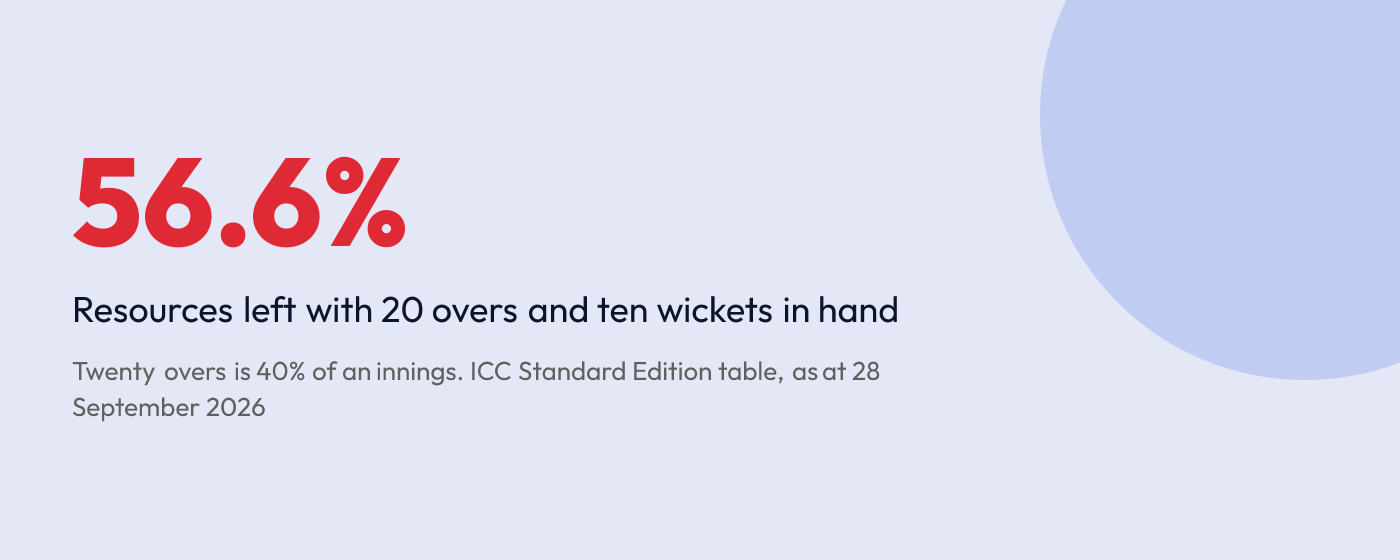
- In the ICC Standard Edition table, 20 overs with all ten wickets in hand is worth 56.6% of a full innings, not 40%.
- When the chasing side has fewer resources, its target is the first score multiplied by R2/R1, rounded down, plus one run.
- Targets can go up when the first innings was interrupted, using an average 50-over score (G50) of 245 for full-member matches and 200 for women's internationals.
- Under the ICC's standard playing conditions, a result needs at least 20 overs per side in an ODI and 5 overs per side in a T20I.
Rain stops play in a one-day game, overs are lost, and a new target flashes up on the scoreboard. Often it looks odd: sometimes higher than a simple run-rate sum would suggest, sometimes lower. That number comes from the Duckworth-Lewis-Stern method, usually shortened to DLS.
This explainer walks through what DLS measures, how the target is calculated, and why it produces the numbers it does. Every table figure below comes from the ICC's published Standard Edition of the method, checked as at 28 September 2026.
What problem was DLS invented to solve?
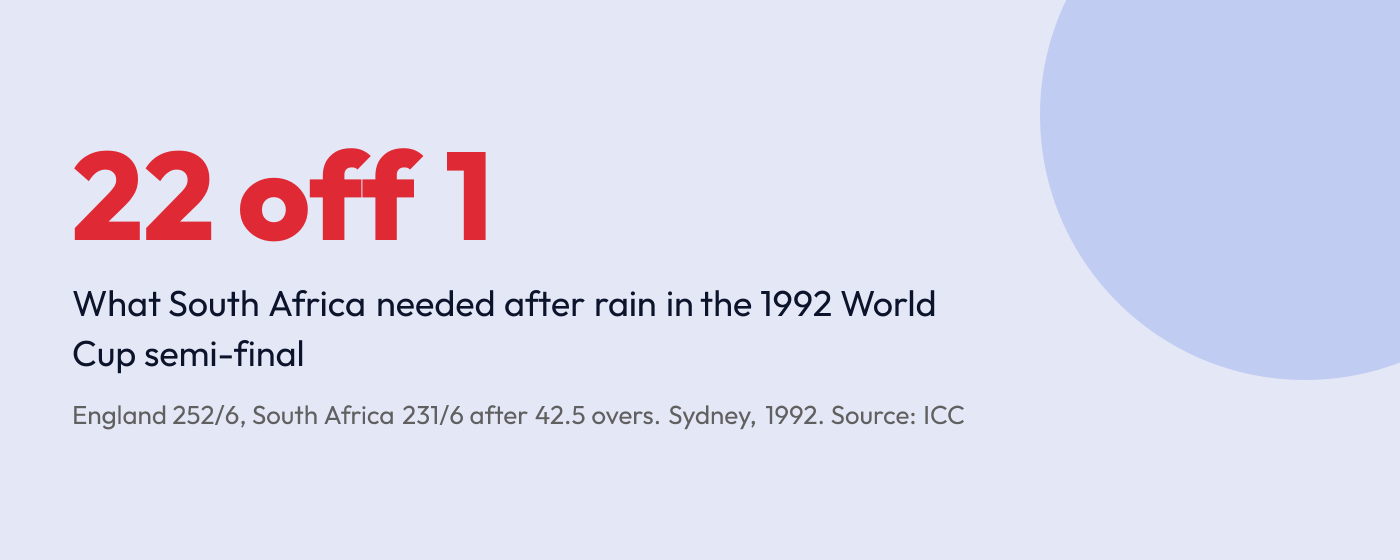
Before DLS, rain rules mostly scaled a target by overs alone. The best-known failure came at the 1992 World Cup semi-final in Sydney. England made 252 for 6, and South Africa had reached 231 for 6 after 42.5 overs when rain arrived. According to the ICC's own tournament review, when play resumed South Africa were left needing 22 runs off the last ball.
Two English statisticians, Frank Duckworth and Tony Lewis, built the replacement. The ICC records that the first international decided with their method was Zimbabwe against England at Harare on 1 January 1997. Australian professor Steven Stern became custodian of the method in 2014 when Duckworth and Lewis retired, which is why it now carries three names.
What does DLS actually measure?
The core idea is resources. A batting side has two things to spend: overs and wickets. DLS treats the combination as a single percentage of the run-scoring potential of a full 50-over innings with all ten wickets in hand.
The key point is that the two are not interchangeable. Losing overs matters less when you have plenty of wickets, and losing wickets matters more when you have plenty of overs. The ICC's methodology document puts it directly: resources depend on how many overs are to go and how many wickets are down, not on overs alone.
Here is a slice of the ICC Standard Edition table. Each figure is the share of a full innings' resources still remaining.
| Overs left | 0 wickets down | 3 down | 5 down | 8 down |
|---|---|---|---|---|
| 50 | 100.0% | 74.9% | 49.0% | 11.9% |
| 30 | 75.1% | 61.6% | 44.7% | 11.9% |
| 20 | 56.6% | 49.1% | 38.6% | 11.9% |
| 10 | 32.1% | 29.8% | 26.1% | 11.4% |
| 1 | 3.6% | 3.6% | 3.5% | 3.2% |
Source: ICC, Duckworth-Lewis Standard Edition resource table (over by over). Checked 28 September 2026.
Read down the first column. Twenty overs is 40% of a 50-over innings, but a side with 20 overs and all ten wickets still has 56.6% of its resources. That is the whole argument against a pure run-rate rule. A team with wickets in hand bats more aggressively, so the last overs of an innings are worth more than the first.
Now read across. With 30 overs left, losing five wickets takes resources from 75.1% to 44.7%. With eight down, the column barely moves at all, because a side that deep into its tail cannot use the overs it has left.
How is the revised target calculated?
The ICC's methodology sets out three cases, using S for the first side's score, R1 for the resources the first side had and R2 for the resources the chasing side has.
- R2 less than R1: the target is the first side's score scaled down by the ratio, plus one. In symbols, S × R2 / R1 + 1, rounded down.
- R2 equal to R1: no change. The target is S + 1.
- R2 greater than R1: the chasing side has more resources than the first side had, so the target goes up. The extra runs are the excess percentage applied to an average 50-over score called G50, then one run is added.
G50 is set by the ICC, not by the match. The ICC document gives 245 for matches involving full member nations, and 200 for women's internationals, under-19 and under-15 internationals, and matches between associate members. That is one of the few places in the method where men's and women's cricket are treated differently.
What does a real calculation look like?
The ICC document includes worked examples. The first covers the most common case: a delay before the chase starts.
A side scores 212 in a 45-over match. Rain then cuts the chase to 35 overs. From the table, 45 overs with no wickets lost is 95.0%, and 35 overs with no wickets lost is 82.7%. So the target is 212 × 82.7 / 95.0 + 1, which comes to 185 after rounding down.
| Method | Target in 35 overs | How it is worked out |
|---|---|---|
| DLS Standard Edition | 185 | 212 × 82.7 / 95.0, rounded down, plus 1 |
| Simple run-rate scaling | about 166 | 212 × 35 / 45 is 164.9 to tie (CPL's own arithmetic) |
The gap is nearly 20 runs. The chasing side loses ten overs but keeps all ten wickets, so it can attack from ball one. DLS charges it for that advantage; a run-rate rule does not.
Why does the target sometimes go up?
This is the case that confuses most viewers. It happens when the side batting first loses overs mid-innings but the chasing side gets a full, known allocation from the start.
The ICC's example: in a 50-over match, the first side is 79 for 3 after 20 overs when rain costs 20 overs, ten from each side. At the stoppage it had 61.6% of its resources left (30 overs, three down). On resumption it had 49.1% (20 overs, three down). It lost 12.5%, so its total resources were 87.5%. It finished on 180 in 40 overs.
The chasing side starts with 40 overs and no wickets lost, which is 89.3%. That is more than 87.5%, because it knows from the first ball that it has 40 overs and can pace the innings for them. The first side did not; it was batting for 50 when the rain came. So the target rises above 181, to 185, using the G50 formula.
What happens if rain ends the match during the chase?
If the chase cannot be finished, the chasing side's score is compared with a par score. Par is what the target formula gives without the extra run: the score a side "should" have with the resources it has used.
The ICC's multi-stoppage example shows how it works. The first side makes 250 in a full 50 overs. The chase reaches 40 for 1 after 12 overs, then ten overs are lost. Resources drop from 82.0% to 68.8%, so the target becomes 218 from 38 overs.
Later a second stoppage costs two more overs, cutting the target to 209. Then rain ends the match with the chasing side on 154 for 6 and 7.4 overs left. The 19.4% of resources that were never used are written off, the par score works out at 159, and the first side wins by five runs.
The margin in a DLS result is always stated in runs when the match is abandoned, whichever side wins. The ICC's example is "Team 1 wins by 5 runs", and a chasing side ahead of par is also said to win by runs, not wickets.
How many overs make a match?
DLS can only settle a game once both sides have had a minimum number of overs. Below that, the result is a no result. As at 28 September 2026, the ICC's playing conditions set these minimums.
| Match type | Minimum overs for each side | Source |
|---|---|---|
| ODI (men's standard conditions) | 20 | ICC Men's ODI Playing Conditions, clause 16 |
| T20I (women's standard conditions) | 5 | ICC Women's T20I Playing Conditions, clause 16 |
| Men's T20 World Cup 2026, group matches | 5 | Tournament playing conditions, clause 16 |
| Men's T20 World Cup 2026, semi-finals and final | 10 | Tournament playing conditions, clause 16 |
The exceptions are common sense: if a side is bowled out, or the chasing side wins, inside the minimum, the result stands. Tournament rules can vary these numbers, so check the event's own playing conditions. The series and tournaments page lists what is running now, and the match schedule shows the next fixtures where the weather may have a say.
Is the Standard Edition what umpires actually use?
No, and this matters. The table above is the Standard Edition. The ICC's methodology says international matches use the DLS software, known as the Professional Edition, and the Standard Edition is the fallback only if the computer fails. The ICC notes that the Standard Edition was the method in use before October 2003.
The Professional Edition uses the same resource idea but a more detailed model, so its targets can differ from the table by a few runs. The worked examples here show how the method thinks, not the exact number you will see on a broadcast. For the live figure during an interrupted game, follow the match on live scores.
What does DLS not do?
A few things are outside the method. The ICC document states that slow over rates carry no overs penalty in the calculation, so a fielding side that falls behind the clock does not shift the target that way. Penalty runs have their own handling: runs awarded to the chasing side's opponents during the chase lift the target and every par score by that amount, rather than triggering a recalculation.
DLS also does not decide how many overs are lost. That is the umpires' job under the playing conditions. DLS only turns the overs that remain into a fair target.
Frequently asked questions
DLS stands for Duckworth-Lewis-Stern, the method used to set revised targets in rain-affected limited-overs matches. It was devised by English statisticians Frank Duckworth and Tony Lewis and first decided an international on 1 January 1997, Zimbabwe v England at Harare. Australian professor Steven Stern became its custodian in 2014, which added his name.
Each side's batting resources are read from a table of overs remaining and wickets lost. If the chasing side has fewer resources than the side batting first, the target is the first score multiplied by the ratio of the two, rounded down, plus one run. If it has more, extra runs are added using an average 50-over score called G50.
It rises when the side batting first loses overs mid-innings but the chasing side knows its full allocation from the first ball. The first side was pacing a longer innings when rain came, so it used fewer resources than the chasing side has. DLS adds runs to cover that gap, based on an average 50-over total set by the ICC.
The par score is the score a chasing side is expected to have reached for the resources it has used so far. It is the target formula without the extra run. If rain ends the match during the chase, the chasing side wins if it is above par, the match is tied if level, and the side batting first wins if it is below.
Under the ICC's standard playing conditions, both sides must have had the chance to bat for at least 20 overs in an ODI and 5 overs in a T20I, unless one side is bowled out or the chase is completed sooner. Tournaments can set different numbers; the 2026 Men's T20 World Cup required 10 overs in its semi-finals and final.
The method and resource table are the same. The difference is G50, the average 50-over score used when a target has to be raised. The ICC's methodology document gives 245 for matches involving full member nations and 200 for women's internationals, under-19 and under-15 internationals, and matches between associate members.
Sources
- Duckworth-Lewis methodology for re-calculating the target score in an interrupted match (with Standard Edition tables)
- Duckworth Lewis Stern
- D/L table of resource percentages remaining, over by over (2002 update)
- Duckworth/Lewis/Stern methodology of re-calculating the target score
- ICC Men's Standard ODI Playing Conditions, effective June 2023
- ICC Women's Twenty20 International Playing Conditions, effective June 2023
- ICC Men's T20 World Cup 2026 Playing Conditions
- Ten years at the top for Duckworth-Lewis
- Men's Cricket World Cup 1992: Overview
- Duckworth-Lewis inventor dies
Statistics in this article were checked as at 28 September 2026.