The highest successful run chase in men's ODIs is South Africa's 435 against Australia at Johannesburg in 2006, won with 438 for 9. India's 406 against West Indies at Guwahati in September 2026 is second. In women's ODIs, New Zealand's 347 against South Africa in April 2026 is the record, as at 5 October 2026.
Key takeaways
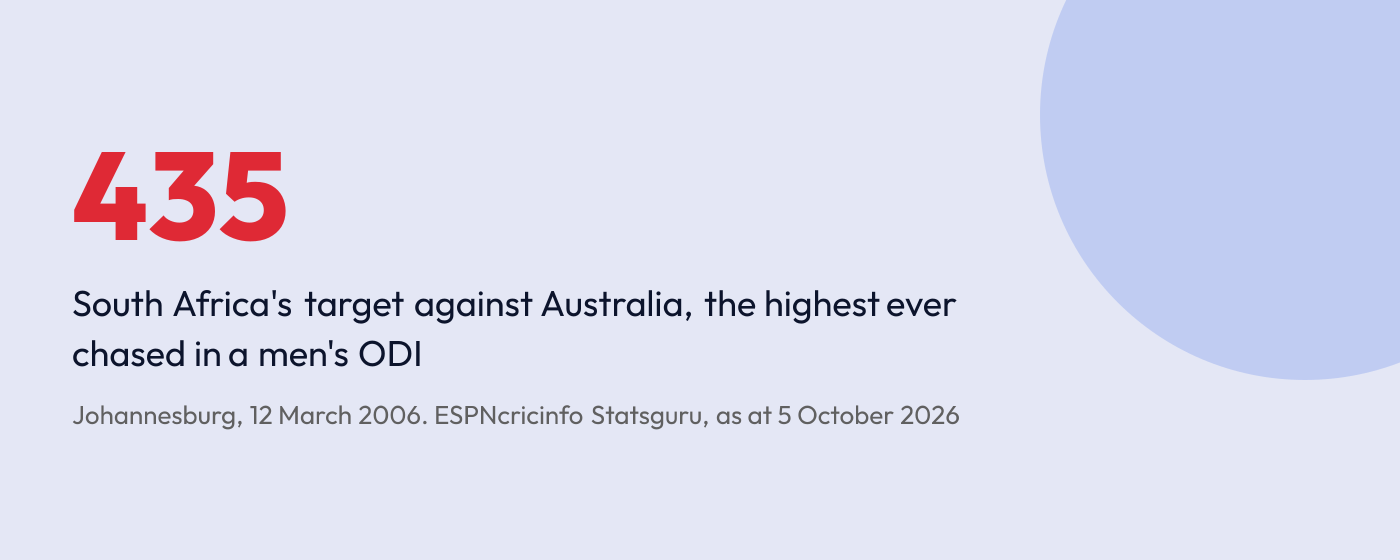
- South Africa's chase of 435 against Australia at Johannesburg on 12 March 2006 is still the highest successful run chase in men's ODIs, as at 5 October 2026.
- India chased 406 against West Indies in Guwahati on 30 September 2026, in 43.3 overs, the only other men's ODI chase above 400.
- West Indies chased 352 against India in New Chandigarh on 3 October 2026, their highest successful ODI chase, with Shai Hope 162 not out.
- Six of the 15 men's ODI chases of 350 or more have come since the start of 2025.
- New Zealand's chase of 347 against South Africa in Wellington on 1 April 2026 is the highest in women's ODIs, beating India's 339 from the 2025 World Cup semi-final.
West Indies chased 352 against India in New Chandigarh on 3 October 2026. Three days earlier, India had chased 406 against West Indies in Guwahati. In one week, two of the 15 biggest successful chases in men's ODI history happened in the same series.
This list ranks every men's ODI chase of 350 or more, plus the biggest chases in women's ODIs. Figures are from ESPNcricinfo Statsguru, as at 5 October 2026.
What counts as a successful run chase?
A run chase is the second innings of a limited-overs match. The chasing side needs one run more than the first innings to win. That number is the target.
There is a catch in how record tables are usually built. Statsguru sorts winning second innings by the chasing side's final score, not by the target. A side that needs 435 and wins with a boundary can finish on 438. So this post ranks by target, which is the first-innings total plus one, taken from the matching Statsguru table.
Two things to keep in mind:
- Targets here are derived from the first-innings totals. All 15 men's first innings in the table below lasted the full 50 overs.
- Chases that were reduced for rain under the DLS method are a different calculation, so a reduced target is not comparable with a full 50-over one.
What are the highest successful run chases in men's ODIs?
Here is every men's ODI chase of 350 or more, as at 5 October 2026.
| # | Target | Chasing side | Final score (overs) | Opposition | Ground | Date |
|---|---|---|---|---|---|---|
| 1 | 435 | South Africa | 438/9 (49.5) | Australia | Johannesburg | 12 Mar 2006 |
| 2 | 406 | India | 406/2 (43.3) | West Indies | Guwahati | 30 Sep 2026 |
| 3 | 372 | South Africa | 372/6 (49.2) | Australia | Durban | 5 Oct 2016 |
| 4 | 370 | Netherlands | 374/6 (49.2) | Scotland | Dundee | 12 Jun 2025 |
| 5 | 361 | England | 364/4 (48.4) | West Indies | Bridgetown | 20 Feb 2019 |
| 6 | 360 | India | 362/1 (43.3) | Australia | Jaipur | 16 Oct 2013 |
| 7= | 359 | South Africa | 362/6 (49.2) | India | Raipur | 3 Dec 2025 |
| 7= | 359 | Australia | 359/6 (47.5) | India | Mohali | 10 Mar 2019 |
| 7= | 359 | England | 359/4 (44.5) | Pakistan | Bristol | 14 May 2019 |
| 10 | 353 | Pakistan | 355/4 (49.0) | South Africa | Karachi | 12 Feb 2025 |
| 11= | 352 | Australia | 356/5 (47.3) | England | Lahore | 22 Feb 2025 |
| 11= | 352 | West Indies | 352/5 (48.2) | India | New Chandigarh | 3 Oct 2026 |
| 13= | 351 | India | 356/7 (48.1) | England | Pune | 15 Jan 2017 |
| 13= | 351 | India | 351/4 (49.3) | Australia | Nagpur | 30 Oct 2013 |
| 15 | 350 | England | 350/3 (44.0) | New Zealand | Nottingham | 17 Jun 2015 |
Source: ESPNcricinfo Statsguru, winning second innings and the matching first innings. Target derived as first-innings total plus one.
The list is complete above 350. Any chase with a target that high has to end on at least that score, and every winning second innings above 345 appears in the Statsguru table this was built from.
Why has South Africa's 438 stood for 20 years?
South Africa needed 435 against Australia at Johannesburg on 12 March 2006 and got there with one ball to spare, at 438 for 9. Australia had made 434 for 4 in their 50 overs.
India's chase of 406 in Guwahati is the only other men's ODI chase above 400. It took 43.3 overs and cost two wickets. The ICC called it the second-highest successful run chase in ODI history.
The two chases worked very differently:
- Johannesburg, 2006: nine wickets down, finished in the final over. The target was reached with almost nothing left.
- Guwahati, 2026: two wickets down, 39 balls to spare (300 balls less the 261 used). Shubman Gill made 223 not out from 133 balls and Rohit Sharma 101 from 75, in an opening stand of 255, according to the ICC.
So the 2006 record still stands on the target, but India's 2026 chase had far more in hand. A target above 435 has not been chased in 20 years.
How did West Indies chase 352 in New Chandigarh?
India batted first in the third ODI and made 351 for 7, with KL Rahul unbeaten on 129. West Indies replied with 352 for 5 in 48.2 overs. Captain Shai Hope made 162 not out, according to the ICC.
ESPNcricinfo's series stats piece says the chase was West Indies' highest successful ODI chase, ahead of the 328 they chased against Ireland in 2019. It was also the third-highest target ever chased successfully against India, behind the two 359s in Raipur and Mohali.
India still won the three-match series 2-1. ESPNcricinfo calculated that the 2,109 runs scored across the three games were the most in any three-match bilateral ODI series.
Which teams chase big totals most often?
Count the chasing sides in the men's table and a pattern shows up.
| Chasing side | Chases of 350+ | Where |
|---|---|---|
| India | 4 | Guwahati, Jaipur, Pune, Nagpur |
| South Africa | 3 | Johannesburg, Durban, Raipur |
| England | 3 | Bridgetown, Bristol, Nottingham |
| Australia | 2 | Mohali, Lahore |
| Pakistan | 1 | Karachi |
| Netherlands | 1 | Dundee |
| West Indies | 1 | New Chandigarh |
CPL count from the Statsguru table above, as at 5 October 2026.
Australia have conceded more of these chases than anyone: four, in Johannesburg, Durban, Jaipur and Nagpur. India have conceded three, all on home soil, and two of those three came in the past ten months.
The Netherlands are the one Associate side on the list. In Dundee, Scotland's George Munsey made 191 from 150 balls. The ICC described it as the highest individual ODI score by an Associate batter. Max O'Dowd replied with 158 not out from 130 balls and finished the chase with a six.
Are 350-plus chases becoming more common?
Yes, clearly. Group the 15 men's chases by when they happened:
| Period | Chases of 350+ |
|---|---|
| 2006–2015 | 4 |
| 2016–2020 | 5 |
| Jan 2025 – Oct 2026 | 6 |
There were none between 2020 and 2024.
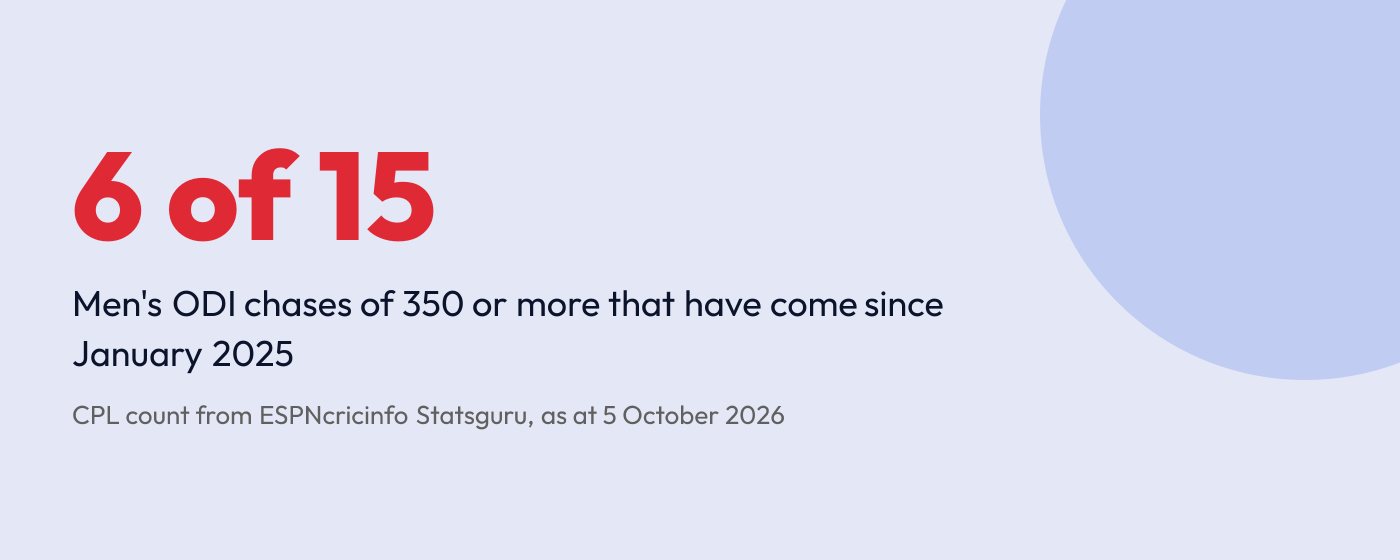
Six of the 15 have come in the 21 months since the start of 2025. They include three of the top seven by target: Guwahati, Dundee and Raipur.
There is no single cause, and this post does not claim one. But the list shows that totals once treated as match-winning are now within reach for a side batting second with wickets in hand.
What are the highest successful run chases in women's ODIs?
The women's record has moved even faster. All three of the biggest chases happened between October 2025 and April 2026.
| # | Target | Chasing side | Final score (overs) | Opposition | Ground | Date |
|---|---|---|---|---|---|---|
| 1 | 347 | New Zealand | 350/8 (49.4) | South Africa | Wellington | 1 Apr 2026 |
| 2 | 339 | India | 341/5 (48.3) | Australia | Navi Mumbai (DY Patil) | 30 Oct 2025 |
| 3 | 331 | Australia | 331/7 (49.0) | India | Visakhapatnam | 12 Oct 2025 |
| 4 | 302 | Sri Lanka | 305/4 (44.3) | South Africa | Potchefstroom | 17 Apr 2024 |
| 5 | 289 | Australia | 289/6 (46.4) | New Zealand | North Sydney | 14 Dec 2012 |
| 6 | 283 | Australia | 285/4 (46.3) | India | Wankhede | 28 Dec 2023 |
| 7= | 282 | England | 283/4 (38.1) | Ireland | Leicester | 1 Sep 2026 |
| 7= | 282 | Australia | 282/2 (44.1) | India | New Chandigarh | 14 Sep 2025 |
Source: ESPNcricinfo Statsguru, as at 5 October 2026. Target derived as first-innings total plus one.
India's chase of 339 came in the second semi-final of the 2025 Women's World Cup. Australia were all out for 338, with Phoebe Litchfield making 119 from 77 balls. Jemimah Rodrigues replied with 127 not out from 134 balls, and her partnership with Harmanpreet Kaur, who made 89, added 167. ESPNcricinfo's report calls it the highest successful chase in women's ODIs at the time. It also ended Australia's unbeaten run at World Cups.
Five months later, New Zealand went past it. At the Basin Reserve, South Africa made 346 for 6. New Zealand were 130 for 4 at the halfway stage, according to the ICC. Captain Melie Kerr then made 179 not out from 139 balls and added 120 with Izzy Gaze, who made 68. New Zealand won with two balls to spare.
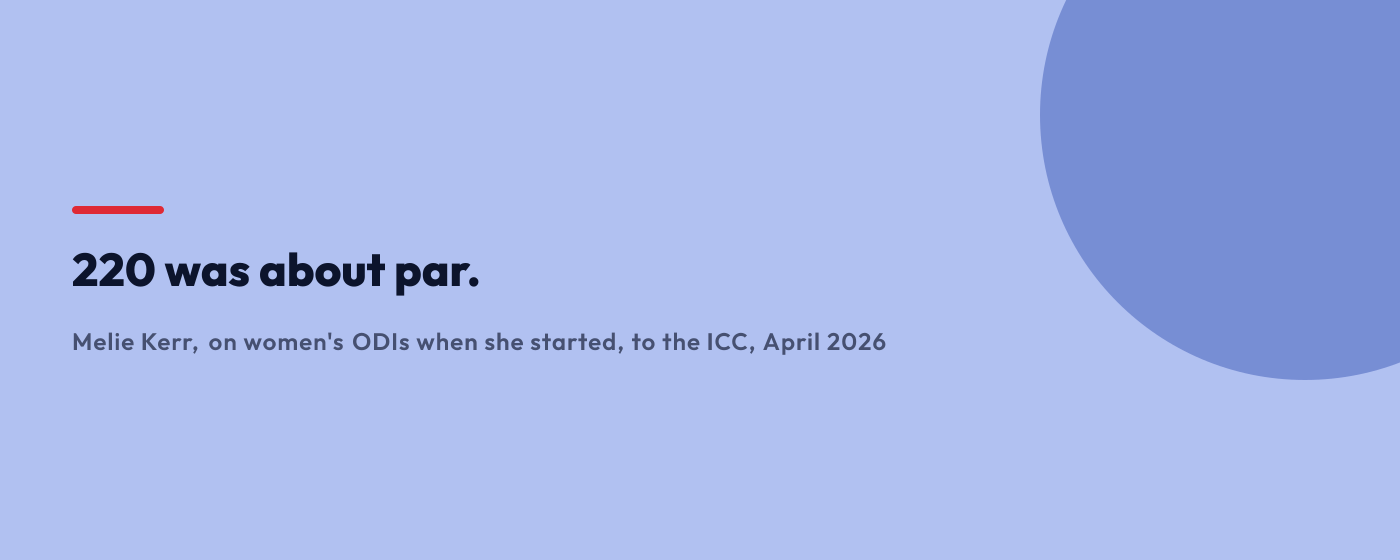
The gap between third and fourth on the women's list is 29 runs: 331 down to 302. A year ago, a 300 target was still close to the women's record. As at 5 October 2026, three sides have chased more than 330.
Where can you follow the next big chase?
Big chases tend to arrive without warning, often on a flat pitch with a short boundary and a side that keeps wickets in hand for the last ten overs.
- Follow chases ball by ball on live scores.
- Check upcoming ODI fixtures on the match schedule.
- See the series and tournaments page for points tables.
A record chase usually only becomes clear in the last ten overs. These tables will be updated when one of these marks falls.
Frequently asked questions
South Africa's chase of 435 against Australia at Johannesburg on 12 March 2006 is the highest in men's ODIs. Australia made 434 for 4, and South Africa finished on 438 for 9 with one ball left. As at 5 October 2026, it has stood for more than 20 years, according to ESPNcricinfo Statsguru.
Twice in men's ODIs, as at 5 October 2026. South Africa chased 435 against Australia in Johannesburg in 2006, and India chased 406 against West Indies in Guwahati on 30 September 2026. India got there in 43.3 overs for the loss of two wickets, with Shubman Gill making 223 not out.
West Indies chased 352 against India in New Chandigarh on 3 October 2026, finishing on 352 for 5 in 48.2 overs. Captain Shai Hope made 162 not out. ESPNcricinfo noted it beat their previous best chase of 328, against Ireland in 2019. India still won the three-match series 2-1.
New Zealand chased 347 against South Africa at the Basin Reserve in Wellington on 1 April 2026, winning by two wickets with two balls to spare. Captain Melie Kerr made 179 not out from 139 balls. It beat India's chase of 339 against Australia in the 2025 Women's World Cup semi-final, as at 5 October 2026.
Not always. Record tables usually sort by the chasing side's final score, but a side can overshoot the target with a boundary. South Africa needed 435 in 2006 and finished on 438. Ranking by target, which is the first-innings total plus one, measures what the chasing side actually had to score.
Sources
- Statsguru: ODI team innings, won batting second, by score
- Statsguru: ODI team innings, lost batting first, by score
- Statsguru: women's ODI team innings, won batting second, by score
- Statsguru: women's ODI team innings, lost batting first, by score
- Records galore as India clinch ODI series against West Indies
- Hope inspires West Indies to record win over India
- Stats: India vs West Indies series breaks run-scoring records
- O'Dowd and Dutch have final say against Munsey muscle in CWC League 2
- India Women v Australia Women, 2nd semi-final, Women's World Cup 2025: match report
- India World Cup mark gone as New Zealand clinch record chase
Statistics in this article were checked as at 5 October 2026.