The ICC women's team rankings rate sides in ODIs and T20Is only. Each team's rating is its ranking points divided by matches played, like a batting average. Points depend on the result and both teams' ratings. Results from the latest year count in full, the two years before at half weight. Australia lead both tables, as at 7 October 2026.
Key takeaways
- As at 7 October 2026, Australia lead the women's ODI rankings on 163 and the women's T20I rankings on 291, according to icc-cricket.com.
- The ICC ranks women's teams in ODIs and T20Is only; there is no women's Test team ranking.
- Until October 2018 the women's rankings were a single model combining Tests, ODIs and T20Is across ten teams.
- A team's rating is its ranking points divided by its weighted match total, and points depend only on the result and the two teams' ratings.
- At the May 2026 update the ICC applied full weight to matches since May 2025 and half weight to the two years before.
Australia sit on top of both women's team rankings. Their T20I rating is 291 after an unbeaten run to the 2026 T20 World Cup title. Their ODI rating is 163. Those two numbers look like they belong to different sports, and in a sense they do.
This post explains how the ICC women's team rankings are worked out, how the system differs from the men's, and what moved after the World Cup. All table figures are from icc-cricket.com, as at 7 October 2026. The live tables are on the ICC rankings page.
How are the ICC women's team rankings calculated?
The ICC describes its team rating as working like a batting average. Instead of runs divided by dismissals, it is ranking points divided by matches played, rounded to the nearest whole number. The method was developed by the statistician David Kendix and is used for men's and women's teams alike.
After every ODI and every T20I, both teams receive points from a formula. According to the ICC, that formula uses only two things: the result, and the two teams' ratings going into the match. Venue, margin and the importance of the game are ignored.
Three rules follow from that, all set out in the ICC's own explainer:
- A win always lifts a rating. The points for a win are always more than the rating a team started with, so the average goes up.
- Opposition strength changes the size of the move. Beating a much stronger side gains more than beating a much weaker one. Losing to a weaker side costs more than losing to a stronger one.
- Nothing is created. The points on offer in a match equal the two teams' starting ratings combined. Ratings are redistributed, not inflated.
How is the women's system different from the men's?
The arithmetic is the same. The structure is not.
| Women | Men | |
|---|---|---|
| Formats ranked | ODI and T20I | Test, ODI and T20I |
| Test team ranking | None | Yes |
| Updated | After every ODI and T20I | After every Test series, ODI and T20I |
| Annual update | Around 1 May | Around 1 May |
Women's Tests are not ranked. The ICC lists women's team rankings for ODI and T20I cricket only.
That was not always the case. A 2017 ICC explainer described the women's rankings as a single model that combined Tests, ODIs and T20Is, treated all three equally, rated ten teams and updated on 1 October each year.
The split came on 12 October 2018. The ICC introduced separate women's ODI and T20I tables, and the first T20I table had 46 teams.
That T20I table followed the ICC's decision earlier in 2018 to give international status to every women's T20 match between Members. In 2018 a side needed six T20Is in the previous three to four years to stay on the table. At the May 2026 update the ICC said 78 teams were ranked, each having played at least eight T20Is over the past three years.
What do the women's ODI rankings look like now?
This is the women's ODI table dated 30 September 2026. "Matches" is a weighted total, explained further down.
| Pos | Team | Matches | Points | Rating |
|---|---|---|---|---|
| 1 | Australia | 28 | 4,565 | 163 |
| 2 | England | 29 | 3,653 | 126 |
| 3 | India | 30 | 3,712 | 124 |
| 4 | South Africa | 36 | 3,614 | 100 |
| 5 | New Zealand | 24 | 2,312 | 96 |
| 6 | Sri Lanka | 24 | 2,133 | 89 |
| 7 | Bangladesh | 21 | 1,537 | 73 |
| 8 | Pakistan | 26 | 1,902 | 73 |
| 9 | West Indies | 29 | 2,085 | 72 |
| 10 | Ireland | 25 | 1,120 | 45 |
Australia's lead over second place is 37 rating points. India are third despite winning the 2025 ODI World Cup at home, their first major ICC title. The ICC's May report noted India then lost 3-0 in Australia early in 2026.
Bangladesh and Pakistan show why the published figure is rounded. Both read 73. Dividing points by matches gives Bangladesh 73.19 and Pakistan 73.15, a CPL calculation from the ICC table, which is why Bangladesh sit seventh.
What moved in the T20I table after the World Cup?
Australia won the 2026 T20 World Cup at Lord's on 5 July, beating England by seven wickets in the final. The ICC reported that both finalists had won six out of six before that match, and that it was Australia's seventh T20 World Cup title.
The comparison below sets the 5 May 2026 annual update against the table dated 5 October 2026.
| Team | 5 May 2026 | 5 Oct 2026 | Change |
|---|---|---|---|
| Australia | 287 | 291 | +4 |
| England | 275 | 276 | +1 |
| India | 264 | 264 | 0 |
| New Zealand | 253 | 249 | -4 |
| South Africa | 243 | 246 | +3 |
| West Indies | 238 | 238 | 0 |
| Sri Lanka | 237 | 238 | +1 |
| Pakistan | 216 | 212 | -4 |
| Ireland | 200 | 203 | +3 |
| Bangladesh | 199 | 195 | -4 |
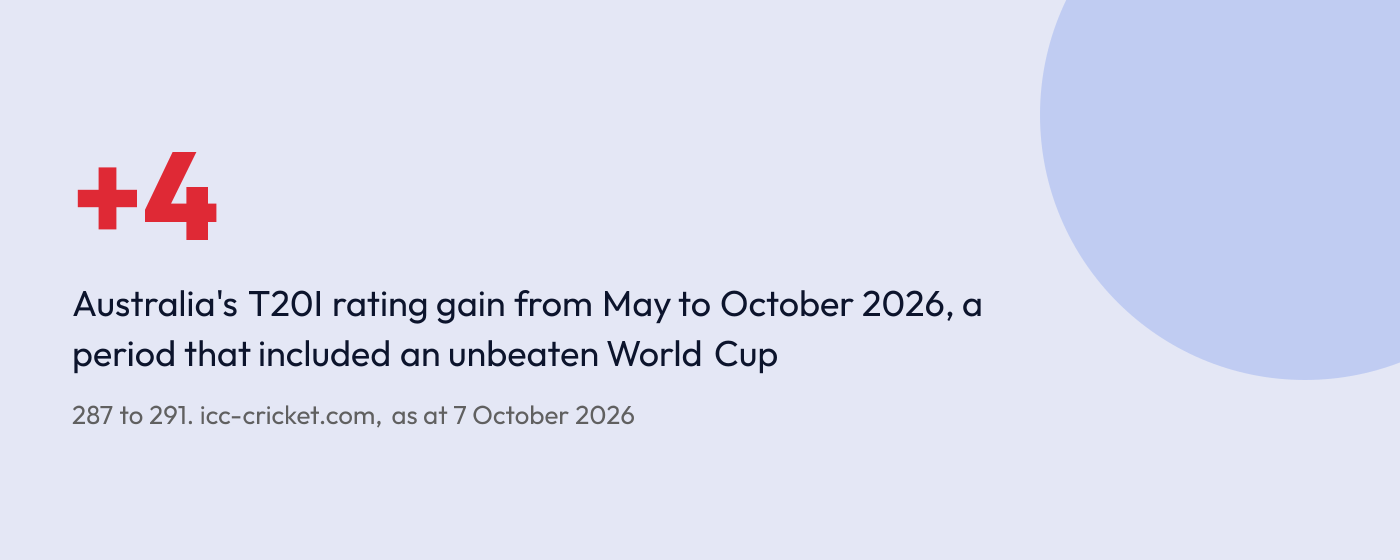
The top ten are in the same order apart from one detail. West Indies and Sri Lanka are now level on 238, with West Indies listed sixth.
Note how small the moves are. Australia won a World Cup without losing and gained four points. That is the averaging at work: a team with more than 25 weighted matches on the books needs many results to shift its mean.
Why do the ODI and T20I ratings look so different?
Australia are 163 in ODIs and 291 in T20Is. The two tables sit on different scales, so a T20I rating cannot be read against an ODI rating.
What carries meaning is the gap between teams in the same table. In ODIs, Australia lead England by 37. In T20Is, Australia lead England by 15.
The ICC's 2017 explainer gives a sense of scale for a table built around 100, written with the Test table in mind:
- A team that wins as often as it loses against an average mix of opponents rates close to 100.
- Several teams in the 90 to 110 range are of broadly similar standard.
- Above 120 suggests consistently strong performances.
- Above 130 is rarely achieved and suggests a high degree of dominance.
The women's ODI table looks built on a similar base: South Africa, fourth, sit on exactly 100. Read that way, Australia's 163 is a long way past the level the ICC calls rare.
Why does beating a weaker side earn so little?
India's next fixtures put this to the test. Smriti Mandhana takes over as captain after Harmanpreet Kaur stepped down on 6 October. India then play Zimbabwe in three T20Is in Raipur from 16 October and three ODIs in Vadodara from 23 October. The ICC says it is the two sides' first bilateral international meeting.
| Format | India | Zimbabwe | Gap |
|---|---|---|---|
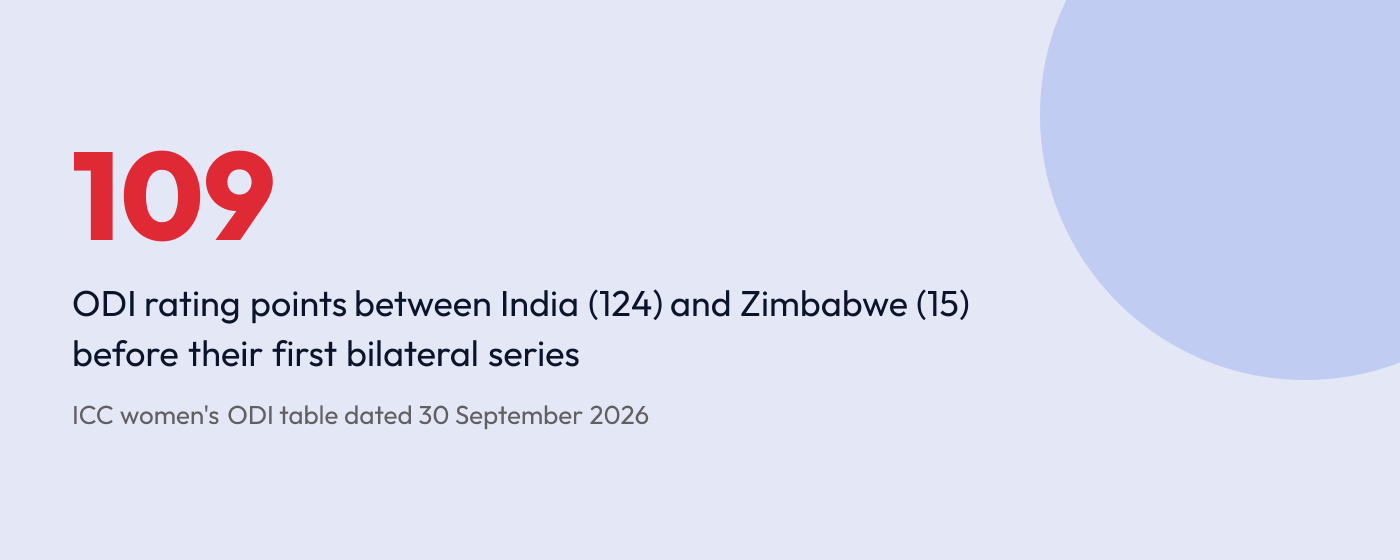
| ODI (30 Sep 2026) | 124 | 15 | 109 |
| T20I (5 Oct 2026) | 264 | 121 | 143 |
Under the ICC's rules, beating a much lower-rated side moves a rating only a little, while losing to one costs more. A clean sweep would barely change India's position. A defeat would cost them more than a defeat to Australia would.
Two other ODI and T20I rules matter here. Each match is rated on its own, so there is no bonus for winning a series, unlike in Tests. And a no result is ignored completely, so a washed-out game in October leaves both ratings untouched.
What happens at the annual update each May?
Once a year the oldest results drop out and the weighting shifts. The ICC's May 2026 T20I update applied full weight to matches played since May 2025 and half weight to the two years before that.
That is why rankings can change overnight without a ball being bowled. It is also why "Matches" in the tables above is not a simple count. Older matches count as half a match, and their points count at half value too.
Teams also fall off the table if they stop playing enough. At the May 2026 ODI update the ICC said Thailand and the Netherlands dropped out after not meeting the minimum match requirement. Both appear again in the 30 September table, Thailand on seven weighted matches and the Netherlands on five.
Where can you follow the women's tables from here?
The next few months are busy for the top sides.
- Rating changes after every ODI and T20I are reflected on the ICC team rankings page.
- India's Zimbabwe fixtures are on the match schedule.
- Every women's series and its table sits under series and tournaments.
The figure to watch is not Australia's lead, which a handful of results will not close. It is the cluster below them. England, India, New Zealand and South Africa sit within 30 T20I rating points of each other, and the order there can change in a single series.
Frequently asked questions
Each team's rating is its ranking points divided by its weighted number of matches, rounded to the nearest whole number. After every ODI and T20I both sides receive points from a formula that uses only the result and the two teams' ratings before the match. Venue and margin are ignored, according to the ICC's explainer.
No. The ICC ranks women's teams in ODI and T20I cricket only. Before October 2018 the women's rankings were one combined model covering Tests, ODIs and T20Is, but since then the ODI and T20I tables have been separate and women's Tests have not had a ranking table of their own.
Australia, on a rating of 291 in the table dated 5 October 2026, ahead of England on 276 and India on 264. Australia were 287 at the May 2026 annual update and gained four points after winning the 2026 T20 World Cup at Lord's without losing a match, according to icc-cricket.com.
The two tables sit on different scales, so a T20I rating cannot be compared with an ODI rating. Australia are 291 in T20Is and 163 in ODIs, as at 7 October 2026. What carries meaning is the gap between teams within the same table, not the raw number across formats.
Around 1 May each year, the same as the men's. The oldest year of results drops out and the weighting shifts, so a team's rating can change without it playing. At the May 2026 update, matches since May 2025 counted in full and the two years before counted at half weight.
Sources
- About the rankings
- Player Rankings FAQs (includes team ranking update schedule)
- MRF Tyres ICC Team Rankings (explainer, 2017)
- ICC Launches Global Women's T20I Team Rankings
- Women's ODI Team Rankings (rank date 30 September 2026)
- Women's T20I Team Rankings (rank date 5 October 2026)
- Australia lead the way in Women's ODI Team Rankings annual update
- Australia remain No.1 in Women's T20I Rankings annual update
- Invincible Australia crowned Women's T20WC champions
- Mandhana takes charge, India name squads for Zimbabwe series
Statistics in this article were checked as at 7 October 2026.