The follow-on lets the side that batted first make its opponents bat again straight away if it leads by enough on first innings. In a five-day Test the lead must be at least 200 runs; in a three or four-day match it is 150. Enforcing it is the leading captain’s choice, and once announced it cannot be changed.
Key takeaways
- In a five-day Test the side batting first needs a first-innings lead of at least 200 runs to enforce the follow-on, under ICC Test playing conditions clause 14.
- If no play is possible on the first day, the required lead is set by the days remaining, so a five-day Test that loses day one drops to 150 runs.
- Enforcing the follow-on is the leading captain’s option, and once the captain has told the umpires and the opposing captain, the decision cannot be changed.
- Only four Tests have been won by the side that followed on: Sydney 1894, Headingley 1981, Kolkata 2001 and Wellington 2023, per ESPNcricinfo’s 2023 count.
- Johan Fourie’s 2026 working paper found eligible Test captains enforced the follow-on 80.5% of the time from 1981 to 2000 and 51.9% from 2001.
A side bowls the opposition out a long way behind and, instead of batting again, sends them straight back in. That is the follow-on. It is one of the oldest tactical choices in Test cricket, and it sits behind some of the most famous turnarounds the format has seen.
This guide covers the rule as the ICC and MCC write it, the history behind the 200-run figure, and why captains enforce it less often than they used to. Facts are as at 14 October 2026.
What is the follow-on in cricket?
In a two-innings match, the side that bats first can make the other side bat again immediately if its first-innings lead is big enough. The trailing side's second innings starts straight after its first. The leading side then bats last, if it needs to bat at all.
The idea is simple. A big lead plus a tired, beaten batting side gives the leaders the best chance to bowl them out twice before time runs out. The innings order changes from the usual A-B-A-B to A-B-B-A.
The rule sits in Law 14 of the MCC Laws of Cricket, and the ICC copies it almost word for word as clause 14 of its men's Test match playing conditions.
How big a lead do you need to enforce the follow-on?
It depends on how many days the match is scheduled to last. The ICC playing conditions set these minimum leads:
| Scheduled match length | Minimum first-innings lead |
|---|---|
| 5 days (standard Test) | 200 runs |
| 3 or 4 days | 150 runs |
| 2 days | 100 runs |
| 1 day | 75 runs |
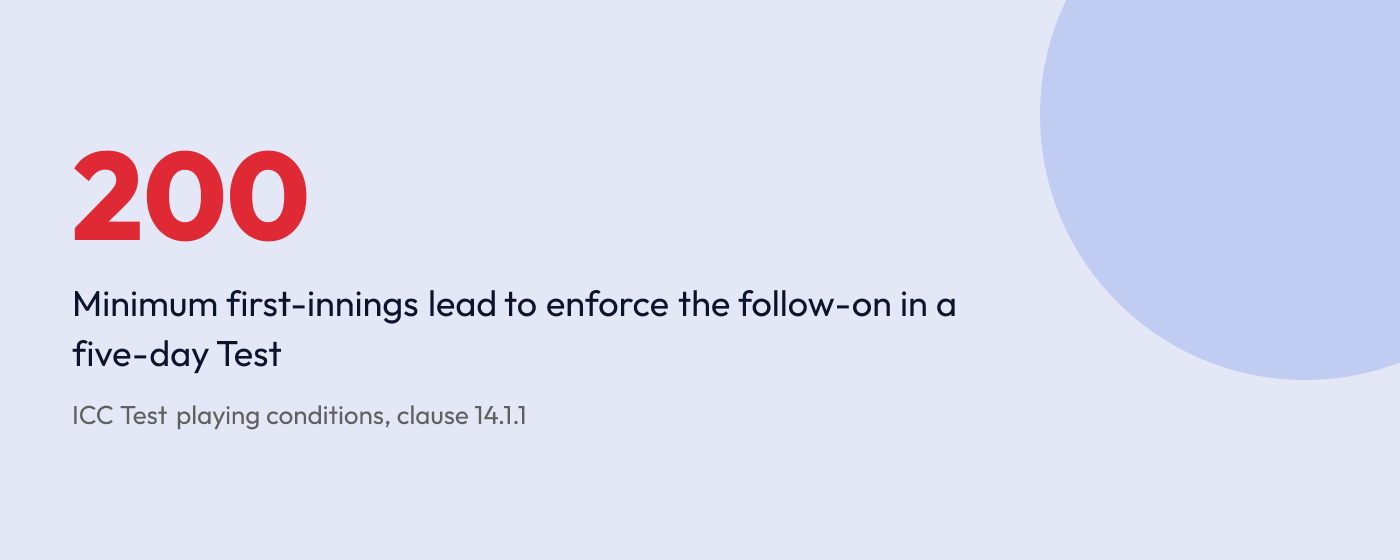
The lead is "at least" the figure, so a lead of exactly 200 in a five-day Test is enough. A lead of 199 is not, which is why a batting side near the mark will fight for every run to "save the follow-on". Domestic first-class matches scheduled for four days play to the 150-run mark.
What happens if the first day is washed out?
The threshold follows the time left, not the time originally scheduled. Clause 14.3 says that if no play takes place on the first day, the lead is set by the number of days remaining from the start of play. The day on which play first starts counts as a whole day, whatever time it begins.
In practice:
- A five-day Test loses all of day one. Four days remain, so the lead needed drops to 150 runs.
- A five-day Test starts at tea on day one after rain. Play has taken place on day one, so the lead stays at 200 runs.
- Play "has taken place" once the first over has started after the umpires call play.
That last point matters. A single ball bowled before the rain returns is enough to keep the higher threshold.
Who decides, and can they change their mind?
Only the captain of the side that leads. It is an option, never an obligation. The captain has to tell the opposing captain and the umpires, and under clause 14.2, once that is done the decision cannot be changed.
The trailing side gets no say at all. Its only influence is to get within the margin before it is bowled out.
It was not always a choice. Before 1900, a side that reached the margin had to enforce the follow-on. A rule history compiled by Stellenbosch University economist Johan Fourie sets out how the threshold has moved:
| Period | Match length | Margin | Enforcement |
|---|---|---|---|
| 1854 to 1893 | Any | 80 runs | Compulsory |
| 1894 to 1899 | Any | 120 runs | Compulsory |
| 1900 to 1979 | 3 days or more | 150 runs | Captain's choice |
| 1980 to present | 5 days or more | 200 runs | Captain's choice |
| 1980 to present | 3 or 4 days | 150 runs | Captain's choice |
So the 200-run mark that fans think of as the follow-on number is a 1980 change. Before that, Tests played to 150.
How often has a team won after following on?
Very rarely. ESPNcricinfo's count, published after New Zealand's win in Wellington in February 2023, put the total at four. CPL's checks on 14 October 2026 found no later instance.
| Test | Batted first | Deficit | Result |
|---|---|---|---|
| Sydney, December 1894 | Australia 586 | 261 | England won by 10 runs |
| Headingley, July 1981 | Australia 401-9 dec | 227 | England won by 18 runs |
| Eden Gardens, March 2001 | Australia 445 | 274 | India won by 171 runs |
| Basin Reserve, February 2023 | England 435-8 dec | 226 | New Zealand won by 1 run |
Deficits are the first-innings gap, worked out from each scorecard.

Three of the four came against Australia. Sydney 1894 is the only one won away from home.

Headingley 1981 is the one most fans know. England followed on 227 behind, and Ian Botham's 149 not out set Australia 130 to win. Bob Willis then took 8 for 43 and Australia were bowled out for 111.
Kolkata 2001 holds the record for the biggest margin. Australia had won 16 Tests in a row, according to Guinness World Records, and led by 274 on first innings. VVS Laxman made 281 and Rahul Dravid 180 as India declared their second innings on 657. That set Australia 384, and Harbhajan Singh, who finished with 13 for 196 in the match, bowled India to a 171-run win.
Wellington 2023 was the tightest. Ben Stokes enforced the follow-on after England led by 226. Kane Williamson made 132 as New Zealand reached 483 and set England 258. England were all out for 256, and Neil Wagner took the last wicket, James Anderson, to win by one run.

Why do captains decline the follow-on?
Four wins in well over a century is a tiny number, so the follow-on is still a very strong position. Yet captains often bat again instead. The reasons are practical rather than superstitious:
- Bowler fatigue. Enforcing asks the same attack to bowl two innings back to back, with no break while their own side bats.
- Batting last. If the leaders enforce and things go wrong, they bat last, on the most worn pitch of the match.
- Time. A big lead plus a quick second innings can leave more than enough time to bowl the opposition out on a wearing surface, with the pressure of a huge target on them.
- Weather. A forecast that cuts the time left can push a captain either way, depending on how quickly they think they can take 10 more wickets.

The numbers suggest the habit has shifted. In Fourie's 2026 working paper, eligible Test captains enforced the follow-on 80.5% of the time from 1981 to 2000, and 51.9% of the time from 2001 onwards.
Kolkata 2001 is often blamed for that change, but the paper is careful: it finds the drop around 2001 is not unusual compared with other years, and draws no causal conclusion from it.
Treat it as a trend, not proof that one match changed every captain's mind.
Does the follow-on apply in ODIs and T20s?
No. The follow-on only exists in two-innings matches, so it applies to Tests and first-class cricket, including the women's Test and multi-day game. One-day internationals and T20s have one innings each, so there is nothing to follow on from.
Where can you watch for it next?
The follow-on comes into play in any Test where one side collapses on first innings. Keep an eye on first-innings totals on the live scores page, and check what is coming up on the match schedule. For the wider Test picture, the series and tournaments page carries every current points table.
Frequently asked questions
In a standard five-day Test, the side that batted first needs a first-innings lead of at least 200 runs. In matches scheduled for three or four days, such as most domestic first-class games, the mark is 150 runs. Two-day matches use 100 runs and one-day matches 75 runs, under ICC playing conditions clause 14 and MCC Law 14.
Yes. If no play takes place on the first day, the required lead is set by the number of days remaining from the start of play. A five-day Test that loses all of day one becomes a four-day match for this purpose, so the lead needed falls from 200 to 150 runs. If even one over is started on day one, the 200 mark stays.
No. It is the option of the captain whose side leads, and the trailing side has no say. Before 1900 the follow-on was compulsory once the margin was reached. Today the captain must tell the opposing captain and the umpires if they want to enforce it, and once they have done so the decision cannot be changed.
Four, according to ESPNcricinfo’s count in 2023: England beat Australia at Sydney in 1894 by 10 runs and at Headingley in 1981 by 18 runs; India beat Australia at Kolkata in 2001 by 171 runs; and New Zealand beat England at Wellington in 2023 by one run. Kolkata is the largest winning margin after following on.
Mainly to rest bowlers and avoid batting last. Enforcing asks the same attack to bowl two innings in a row, and if the opposition bat well second time round, the leading side must chase on the most worn pitch of the match. Many captains prefer to bat again, build a huge lead and bowl last on a tiring surface.
No. The follow-on only exists in two-innings matches, meaning Tests and first-class cricket, including women’s Tests and multi-day domestic games. One-day internationals and T20 matches give each side a single innings, so there is no second innings to bring forward and the rule never comes into play.
Sources
- Men's Test Match Clause 14: The Follow On
- Law 14: The follow-on
- The Decline of the Follow-On in 125 Years of First-Class Cricket: supplemental appendix
- Stats: New Zealand pull off rare follow-on comeback
- World reacts to New Zealand's stunning comeback win over England
- Australia v England, 1st Test, Sydney, 1894-95: scorecard
- England v Australia, Headingley, 1981: scorecard
- Bob Willis and the 1981 Headingley Test
- Greatest Tests of the 21st century: Dravid and Laxman at Kolkata
- Highest victory margin in a cricket Test match after following on
Statistics in this article were checked as at 14 October 2026.